

Data
Every piece of evidence starts from the same product data.
Product, packaging components, material, weight, GTIN and image — maintained once. The declaration of conformity, the product passport and the volume report then all draw on the same record.
- Levels
- Brand, product, packaging
- Per component
- Material, class A–E, weight, units
- Identifier
- GTIN, 8 to 14 digits
- Import
- CSV/Excel or product URL
Ausgangslage
It is not the evidence that is missing, it is the data underneath
The declaration of conformity, the product passport, the volume report and the recyclate evidence are different documents from a single source: the product and its packaging components. If that source has gaps, every piece of evidence breaks at the same point.
- The same packaging appears in the article list, the recyclate sheet and the reporting table — with three different weights.
- Without a GTIN there is no identifier for a standards-compliant product passport to hang off.
- When a packaging changes, nobody knows which generated documents have gone out of date with it.
Der Unterschied
An article list in a spreadsheet, or master data on the product
Both routes hold the same information. The difference shows the moment a second piece of evidence needs the same number.
Article list in a spreadsheet
- The packaging sits as prose in a column: “PET bottle with cap, approx. 24 g”. Readable, not evaluable.
- Material is typed freely — “PET”, “P.E.T.” and “PET bottle” are three materials for any total.
- Every piece of evidence starts with copying: the same number transferred three times, rounded three different ways.
Master data on the product
- Every component is its own record with material, weight, unit count and class A to E.
- The material comes from a fixed list — only that makes aggregation across products possible.
- The downstream modules read the record instead of copying it.
How you work with it
The brand first, then the products
The producer-related details hang off the legal entity, not the article: company name, VAT ID, LUCID number, address and — outside the EU — the authorised representative. They are maintained in the data hub so that there is exactly one place for them. Brand name and company name are not the same thing: in a declaration of conformity it is the legal one that counts.
Create products — by hand, from a file or from a URL
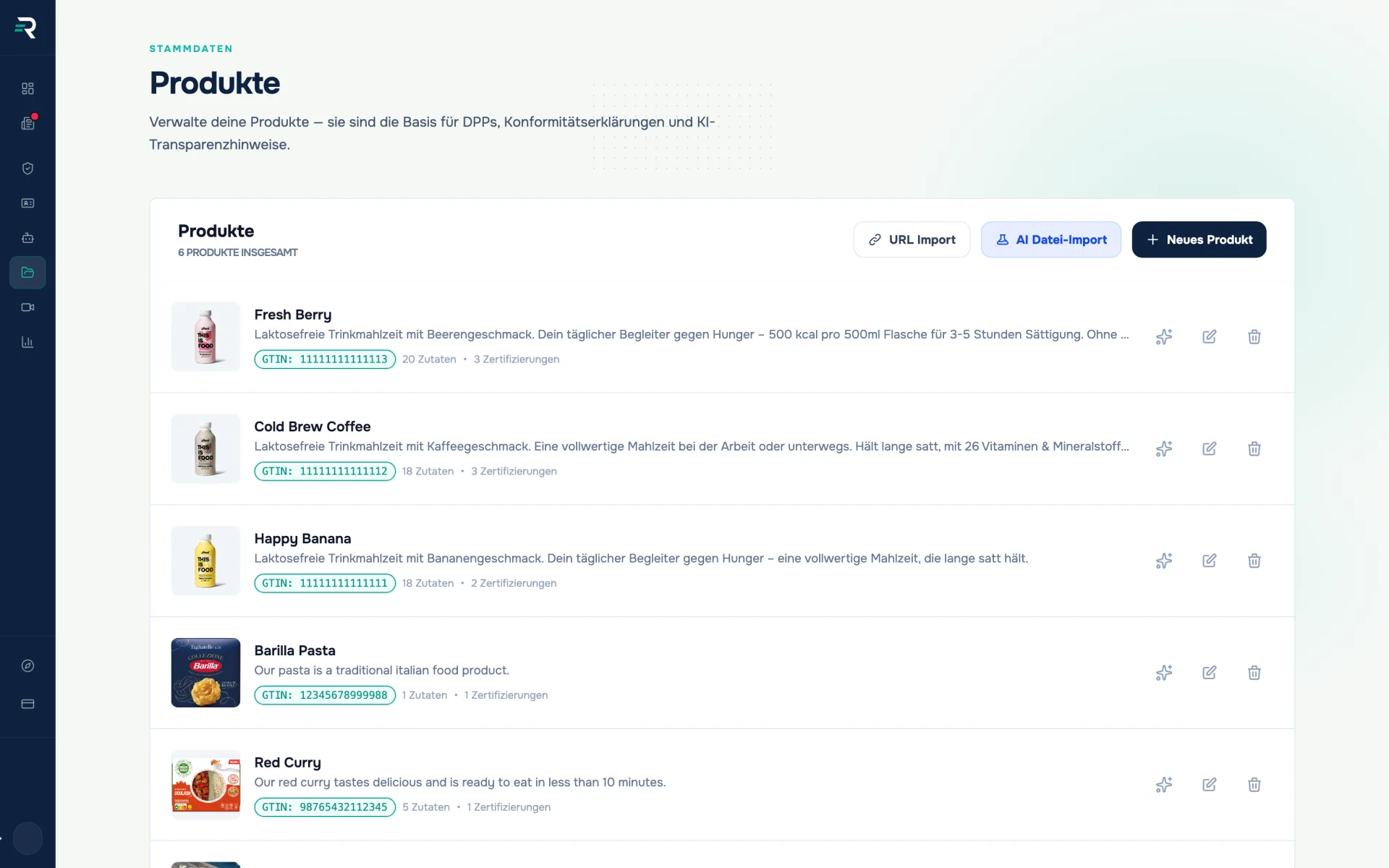
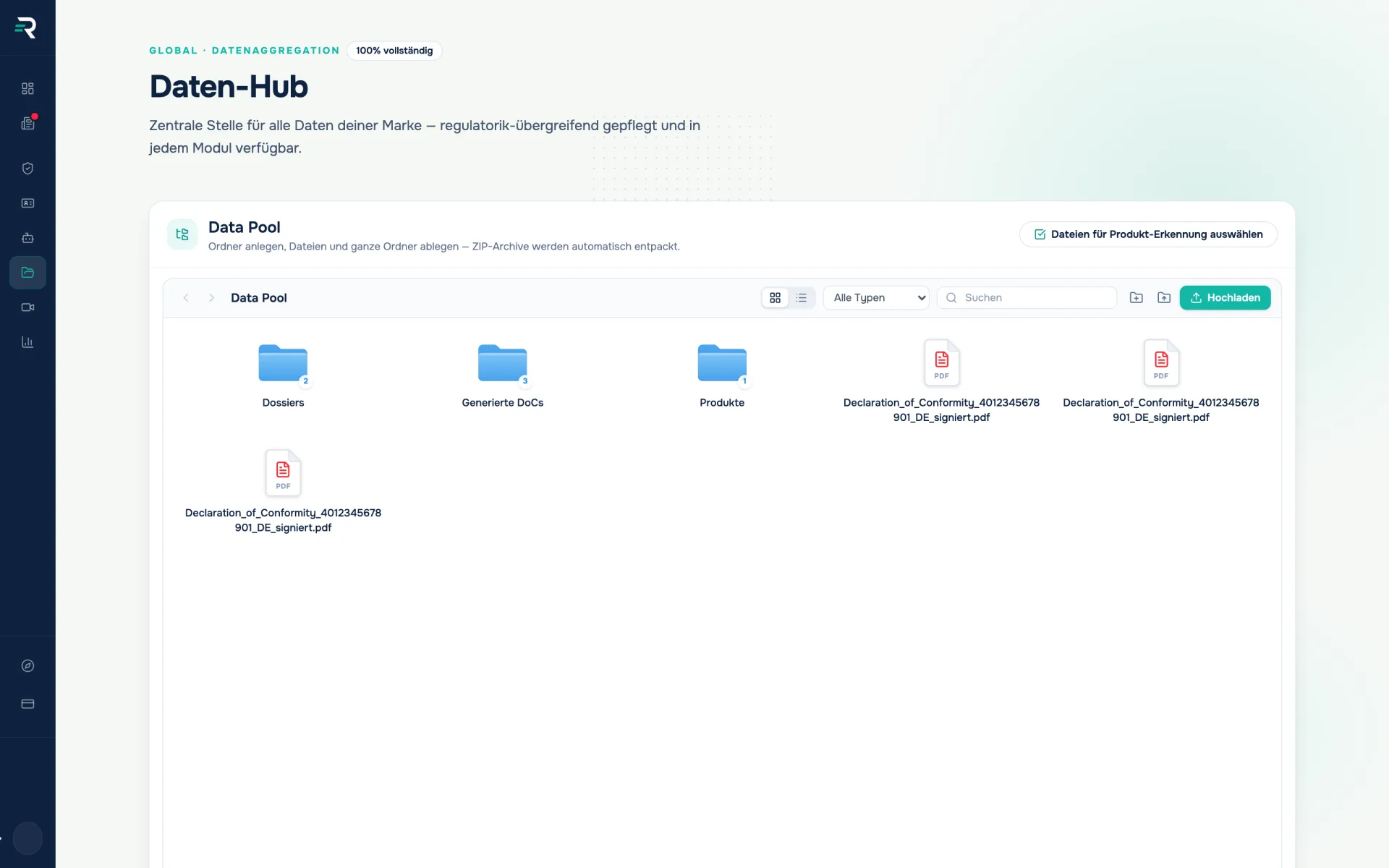
Every row shows the image, name, GTIN badge and the number of stored ingredients and certifications — you can see from the list where something is missing without opening a product. For an existing range there are two shortcuts: the import from CSV, XLSX or XLS, and the import from a shop URL. Both are a proposal, not a free pass — the check happens in the form.
Model packaging as components, not as a text field
Bottle, cap, label and outer carton are four components with four materials — and that is exactly how they are recorded: material, disposal instruction, weight, units per quarter, recyclability class A to E, plus reusable and compostable as tick boxes. The material choice is predefined rather than freely typed; that sounds like a detail and is the reason anything can be added up later at all. The recyclate share sits on the component too — a product-level value would be an invention.
Show only the sections that concern the product
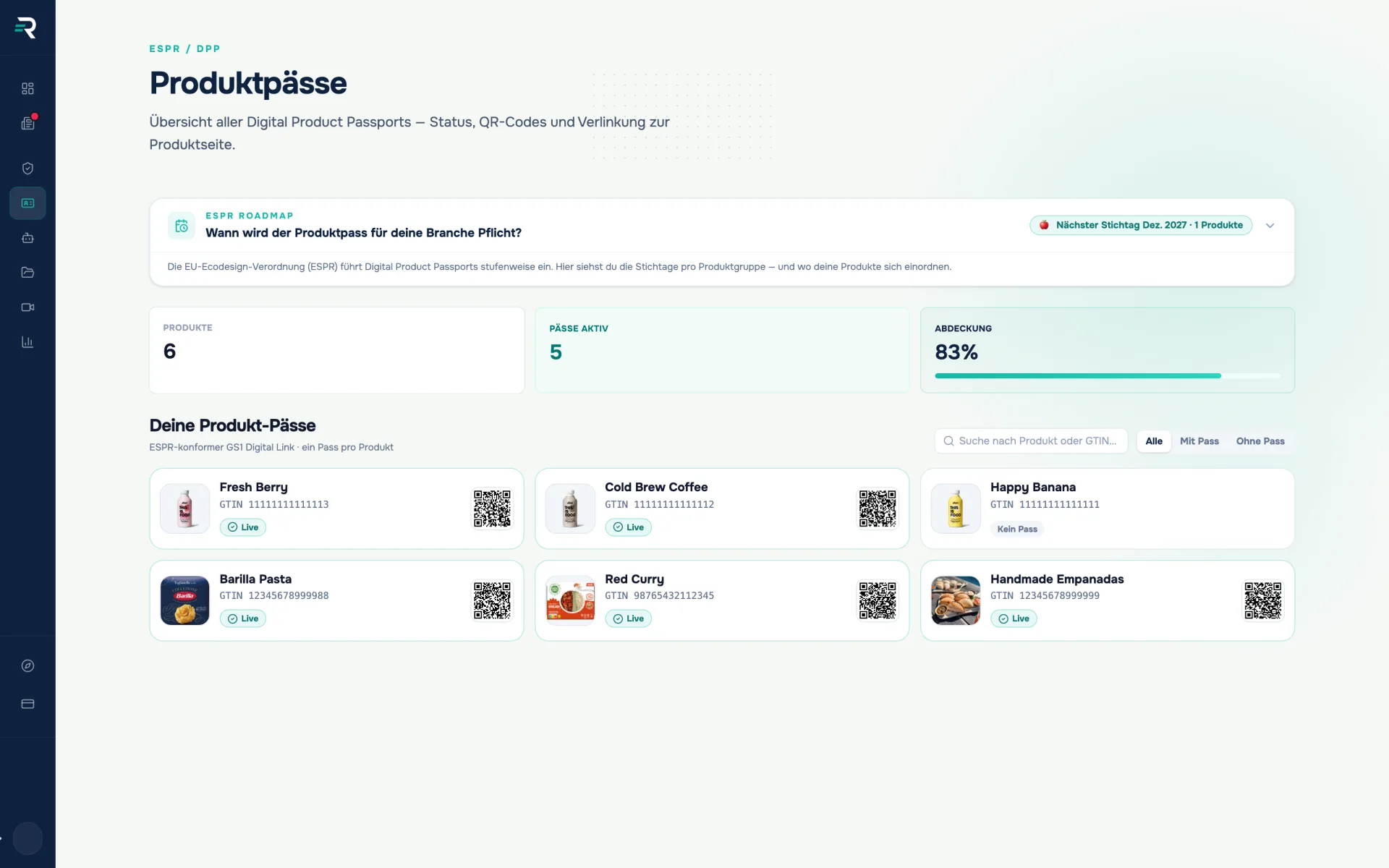
A cosmetics article does not need a nutrition table. So you switch the sections on or off per product — ingredients, nutrition, packaging, substances, documents, FAQ. Where a GTIN exists, Reguly derives a GS1 Digital Link and QR code from it; without a GTIN the code points to the internal product page. The difference only becomes visible on the shelf — but there it is unmistakable.
How it fits together
One set of data that carries forward
01
Data hub
holds the producer-related details
Company name · VAT ID · LUCID number
02
Products & master data
brings product and packaging components together
GTIN · Material per component · Weight · Class A–E
03
Packaging register
aggregates the volumes for the report
Units per quarter · Weight per material
04
Product passports
makes the same record publicly readable
GS1 Digital Link · QR code · Disposal instruction
05
Declarations of conformity
pulls product and manufacturer details into the document
Product designation · Manufacturer details
Frequently asked questions
Do I have to maintain my master data again for every module?
No. Product and packaging components are recorded once; the volume report, the product passport, the recyclate evidence and the declaration of conformity all draw on the same record.
How do I get many products into the system quickly?
Through the AI import from a CSV, XLSX or XLS file, or through the URL import, which pulls the details from an existing shop page. Both create a draft that you check in the form.
Do I absolutely need a GTIN?
For a GS1 Digital Link, yes — it is derived from the GTIN. Without a GTIN the product still works, but the QR code then points to the internal product page rather than to a standards-compliant entry point.
Where is the recyclate share recorded?
Per packaging component, together with material, weight and recyclability class. A value at product level would not hold up: bottle, cap and label have different shares.
Passt dazu
Every value knows where it came from.
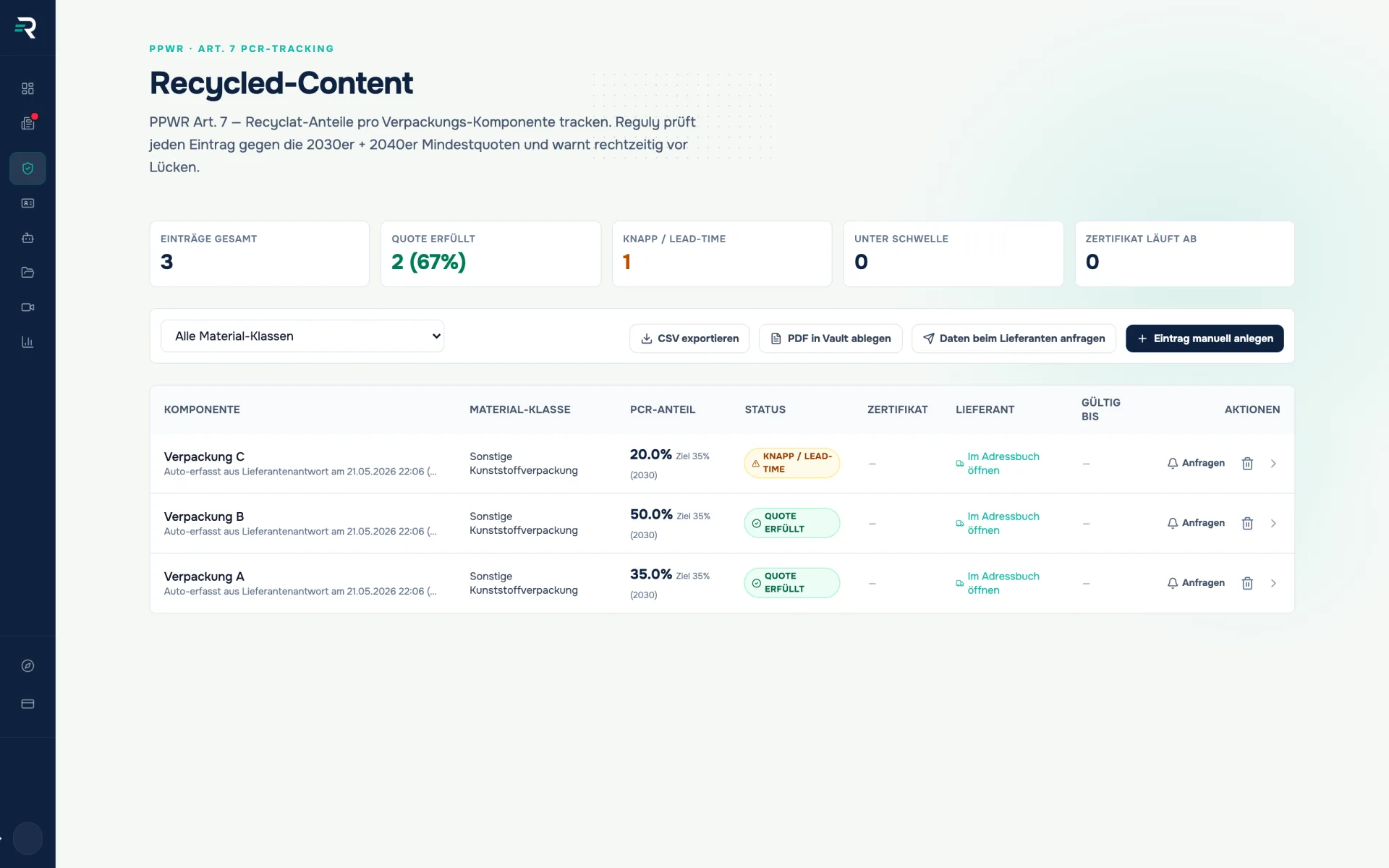
The data hub brings together all packaging data across sources, shows the completeness rate and makes it traceable where every value came from.
A QR code that never has to be reprinted.
Product passports shows for every product whether a Digital Product Passport is live, generates the matching QR code and routes every scan to the public product page.
The volume report grows out of your packaging.
Calculate packaging volumes from your master data, break them down by the eight LUCID material types and system operator, and generate the XML for upload to LUCID.
How far does your data carry you?
Five questions show you which PPWR duties apply to you and where your product data does not yet stretch to cover them — free and without signing up.