

Data & suppliers
Every value knows where it came from.
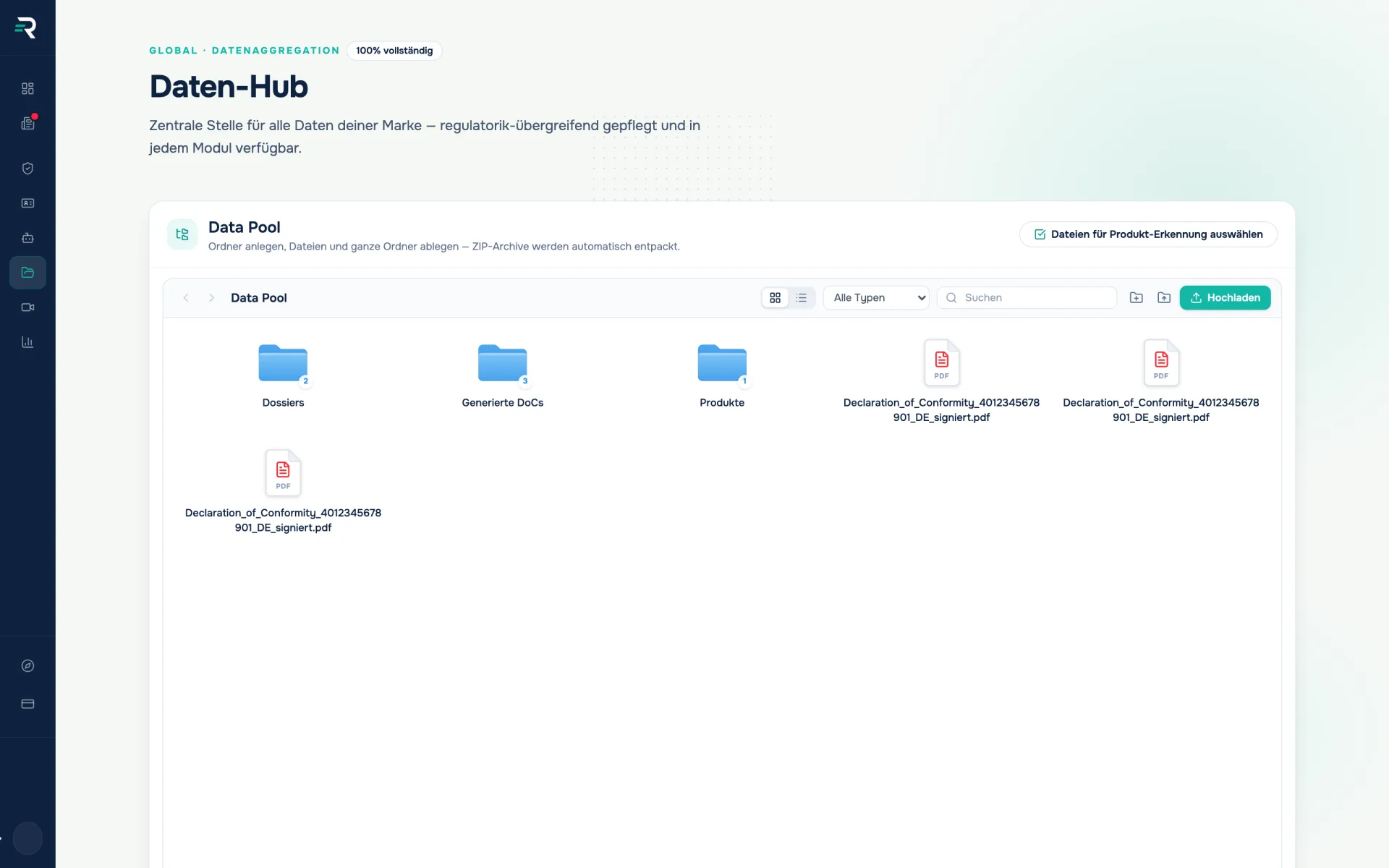
The data hub brings together what is created across four modules — and shows for every data point whether it is present, pending or open.
- Regulation
- PPWR (EU) 2025/40
- Context
- Art. 5, 7, 39, Annex VIII
- Module
- Data hub + data pool
- Sources per value
- 5
Those placing on the market
Your evidence depends on information that sits with your suppliers.
Compliance & purchasing
You work on one dataset instead of passing spreadsheets back and forth.
Consultants & law firms
You check your clients’ data for completeness.
Ausgangslage
PPWR projects fail on the data, not on willingness
Material composition, recyclate share and PFAS values are known to the material supplier — not to the party placing the product on the market. What comes back is spread across email attachments, spreadsheets and folders.
- The same value sits in three spreadsheets, in three versions, at three different dates.
- Nobody can say how complete the dataset is overall — only what happens to be noticed right now.
- In an audit there is no proof of where a value came from and who signed it off.
- Certificates and test reports get searched for again with every case.
How you work with it
Review the dataset
On opening, the hub shows the completeness rate and separates present from pending data points. It is a view onto what is created in the modules anyway — not a second data-entry form.
Assign the gaps
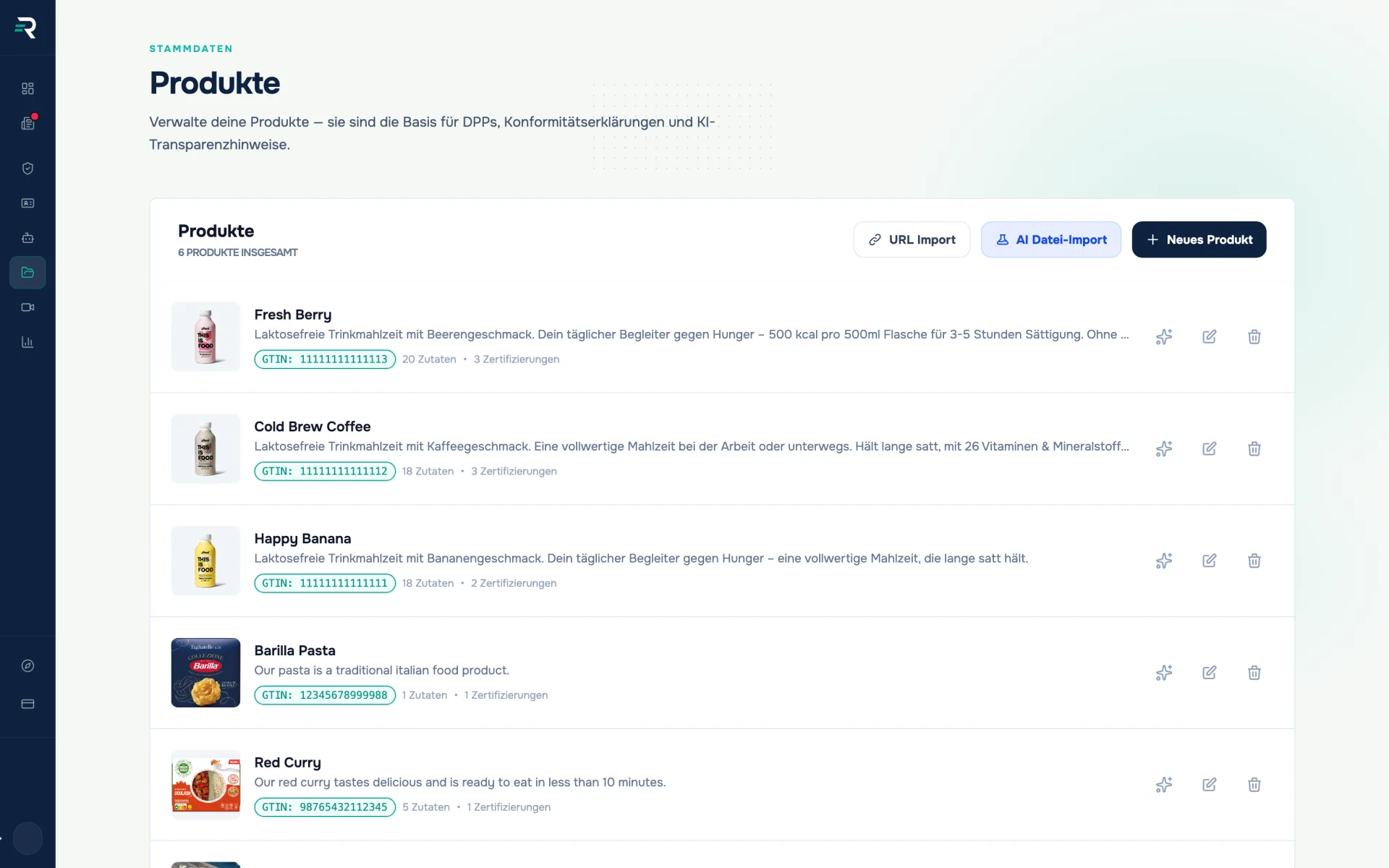
Every open point hangs off a product or a packaging component. From that follows who has to supply the information.
Trigger the source
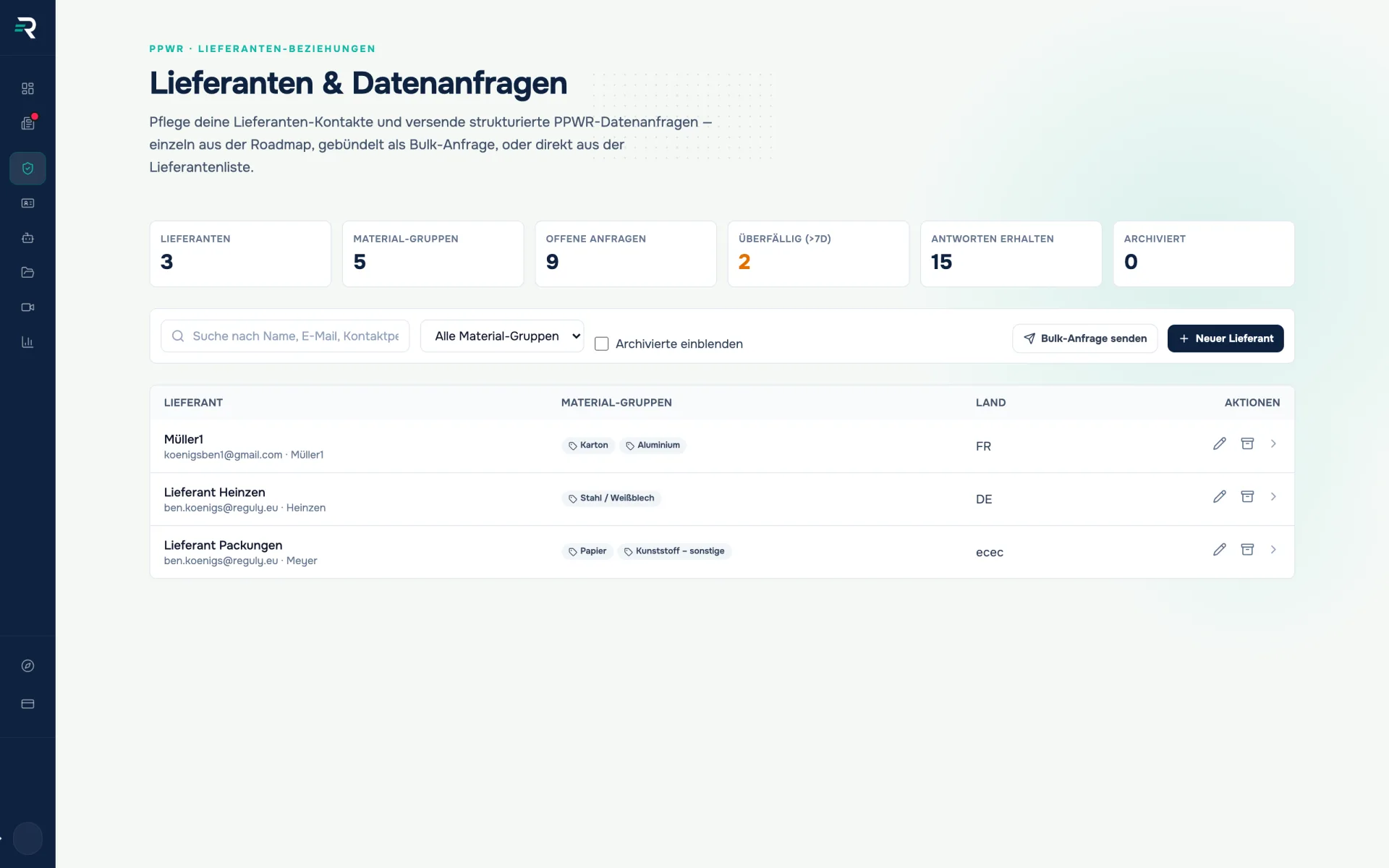
If a supplier detail is missing, a structured data request goes out. If a document is missing, it moves into the global data pool — PDF, Excel, Word and images up to 20 MB.
Check and release
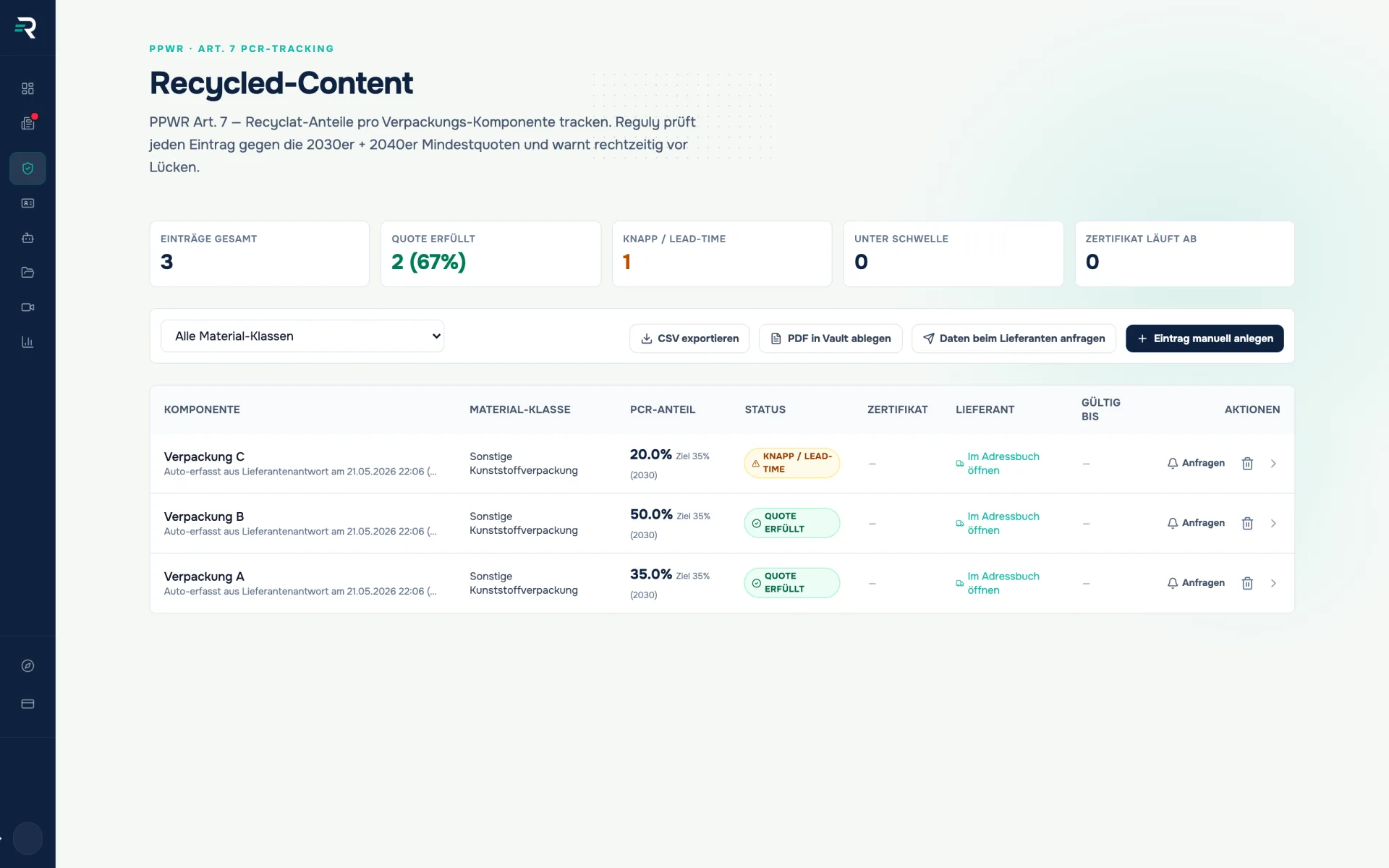
You check incoming values in the review and release them. Only then do they count as present. The AI extraction supplies a suggestion with a confidence value — nothing is taken over unchecked.
What matters most
Provenance instead of trust
For an audit it is not only that a value exists that counts, but where it came from. Every data point carries its source — DoC generator, data request, data pool, roadmap or manual — and where a history exists, released states can be inspected. That is the difference between a well-kept spreadsheet and evidence that holds.
How it fits together
One set of data that carries forward
01
Supplier requests
fetches the values from outside
Material composition · Recyclate share · PFAS & heavy metals
02
Data hub
brings them together and evidences their provenance
checked value · source · version
03
DoC generator
draws the declaration of conformity from it
DoC under Annex VIII
Frequently asked questions
Can I see where a single value came from?
Yes. Every entry carries a source — DoC generator, data request, data pool, roadmap or manual. Where a version history exists, the released states can be inspected.
Do I have to maintain data twice if I have already created products?
No. The hub reads what is created in the modules. It is a view onto the dataset, not a second data-entry form.
Why the data pool if there are data requests?
The pool is meant for recurring standard documents such as certificates, standards and test reports. Data requests, by contrast, collect product-specific values from suppliers.
How reliable is the product detection from documents?
It supplies a suggestion with a confidence value that you confirm or discard in the review dialog. Reguly detects duplicates by GTIN or name. Nothing is taken over without release.
Which file formats does the data pool accept?
PDF, Excel, Word and images up to 20 MB per file.
Passt dazu
The data sits with the supplier. Collect it in a structured way.
Maintain suppliers, send ready-made PPWR data requests as a campaign, have replies evaluated automatically and release them after review — all in Reguly.
Every piece of evidence starts from the same product data.
Maintain products, packaging components, GTIN and images once — the declaration of conformity, the product passport and the volume report all draw their values from it.
Every piece of evidence is ready, none expires quietly.
The compliance vault keeps every piece of evidence in one place — test reports, certificates and declarations, versioned and with expiry monitoring.
Know where you stand
Five questions show you how far your data carries you for the PPWR — free and without signing up.