

Data & suppliers
The data sits with the supplier. Collect it in a structured way.
Material, recyclate share, PFAS: details you do not know yourself. Reguly turns them into a repeatable process instead of an email chain.
- Regulation
- PPWR (EU) 2025/40
- Context
- Art. 5, 7, 39, Annex VIII
- Templates
- 3 with article references
- Follow-up
- overdue after 7 days
Purchasing
You know the contacts — here that becomes a traceable request rather than a loose email.
Compliance
You decide which values are asked for and release what comes back.
Those placing on the market
Your declaration of conformity depends on information created in the supply chain.
Ausgangslage
Collecting data is the longest lead time in a PPWR project
Material composition, recyclate share and PFAS values are known to the material supplier, not to the party placing the product on the market. Ask for them without structure and you get unstructured answers — and have to ask twice.
- Every request is worded afresh — and the answers are correspondingly inconsistent.
- There is no overview of who replied, who is overdue and who has been chased.
- Without a reference to the specific article, the supplier sends what they think is right — not what the evidence needs.
How you work with it
Maintain suppliers
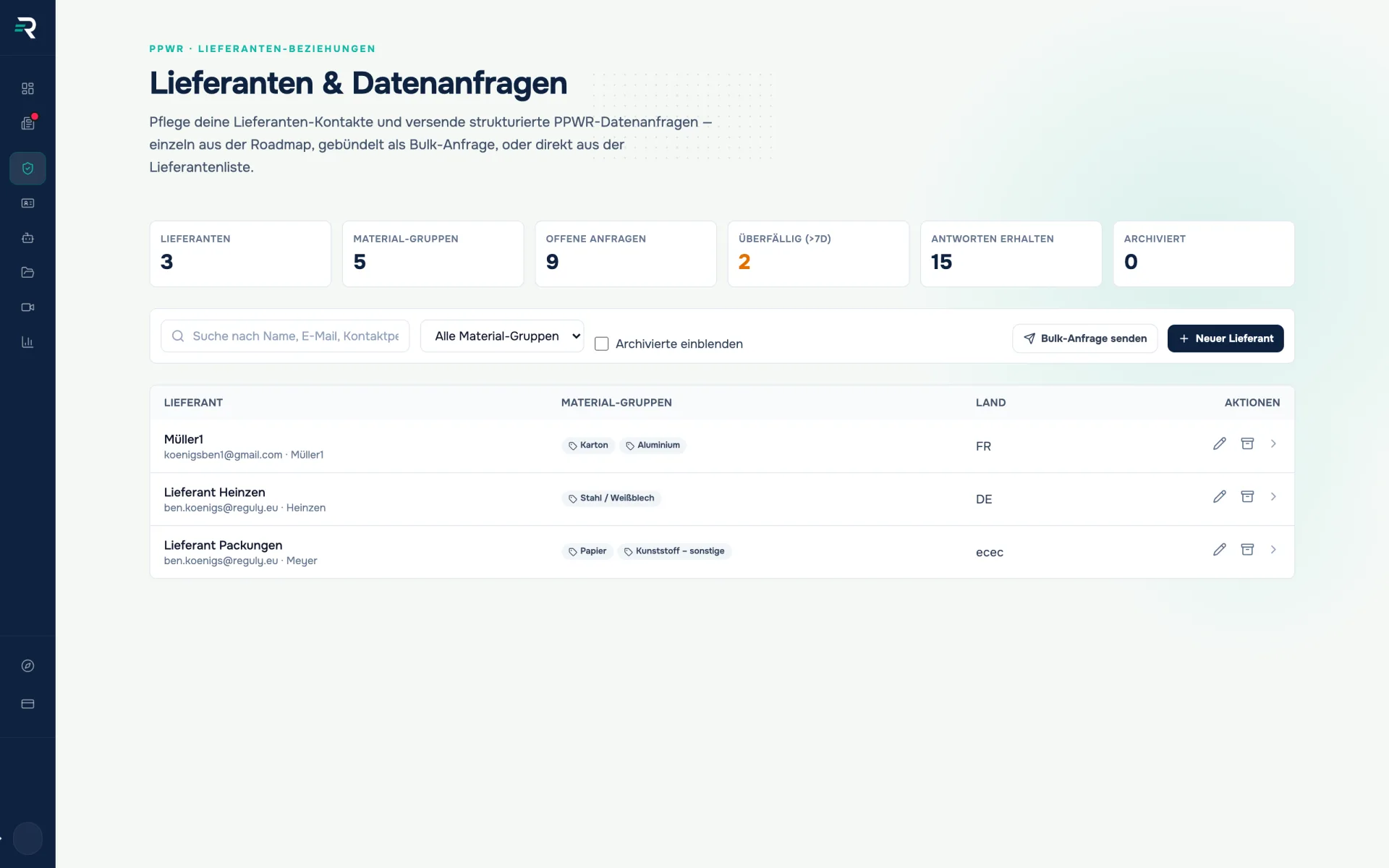
Every supplier gets a name, contact, country and their material groups — predefined and shown as badges in the table, so you can filter instead of search. The figures above show open requests, overdue ones, replies received and what has been archived.
Pick a template
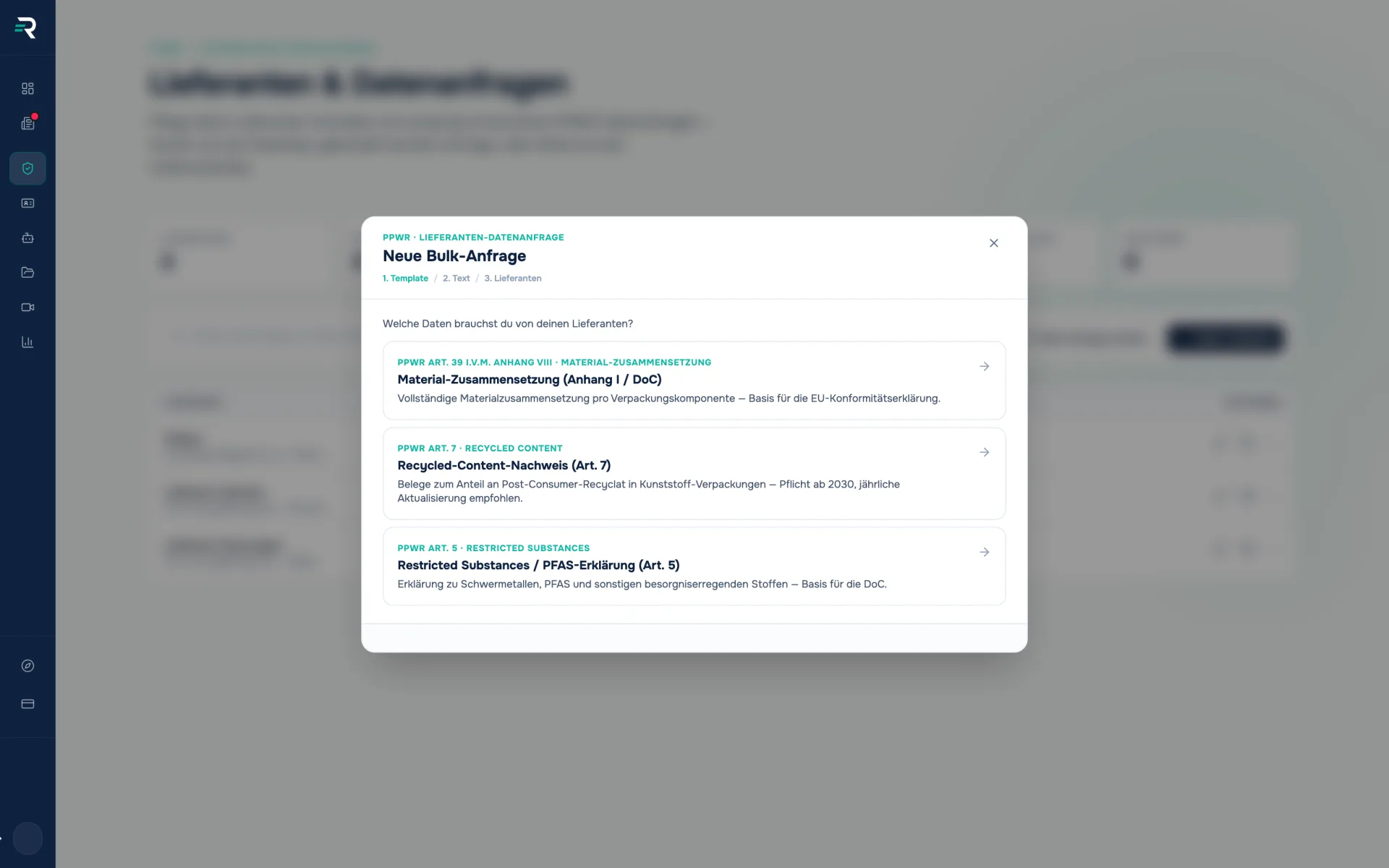
Three ready-made data requests cover the usual PPWR questions: material composition for the declaration of conformity, recycled content under Art. 7, and the declaration on restricted substances and PFAS under Art. 5. Each carries its article reference in the covering text and asks for exactly the fields the corresponding specialist module needs.
Send the campaign
The wizard leads from the template through subject and message to the choice of recipients. The covering text is personalised and goes out to each supplier individually. After that the status per supplier sits in the history: sent, delivered, reply in. Anyone who does not respond shows up as overdue.
Check replies and release them
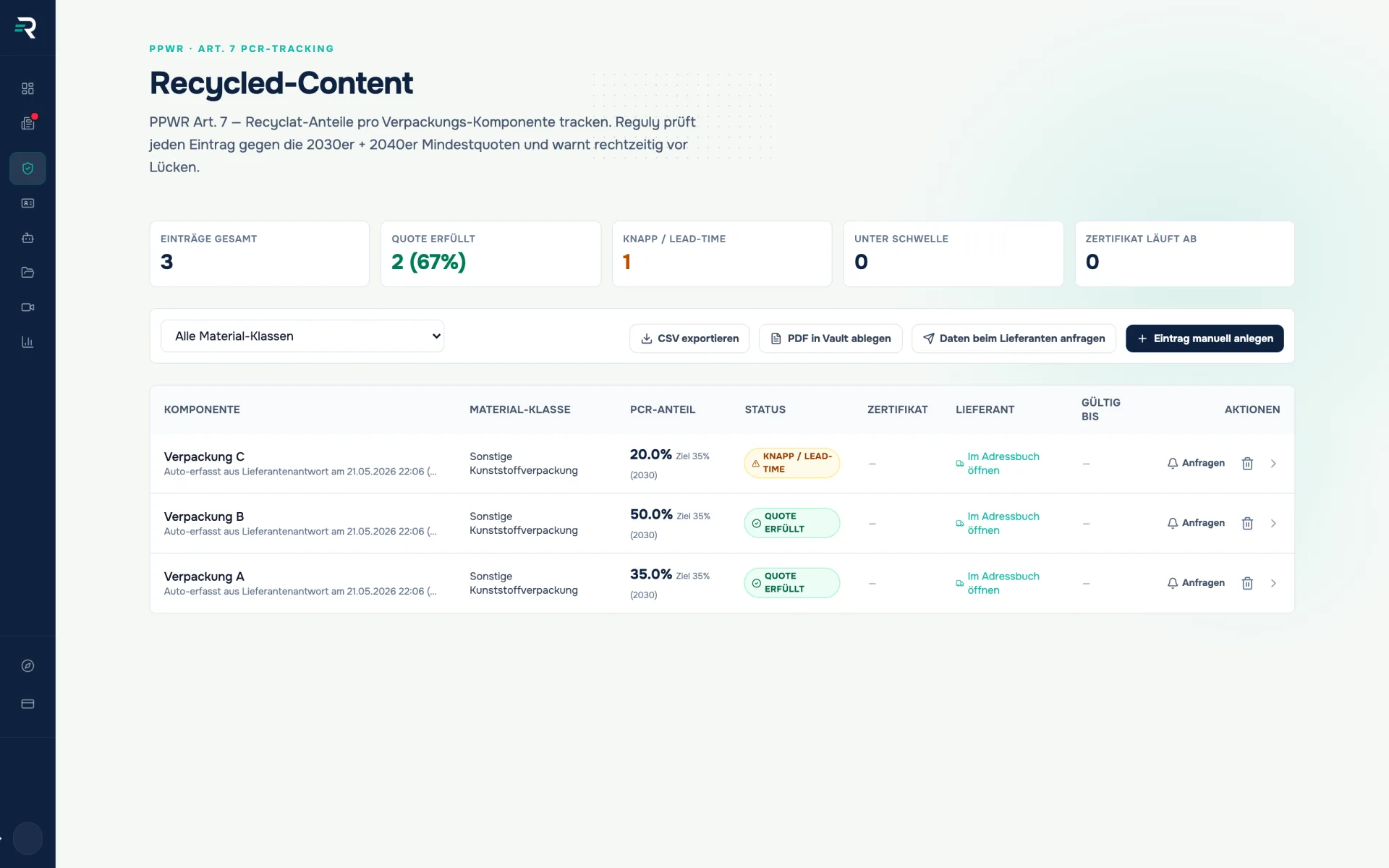
Reguly reads the email text and attachments and proposes the values it detected, with a confidence score. Only with your release does a value move into the specialist module it belongs to — for example into the recycled-content tracking per packaging component.
Keep track of the gaps
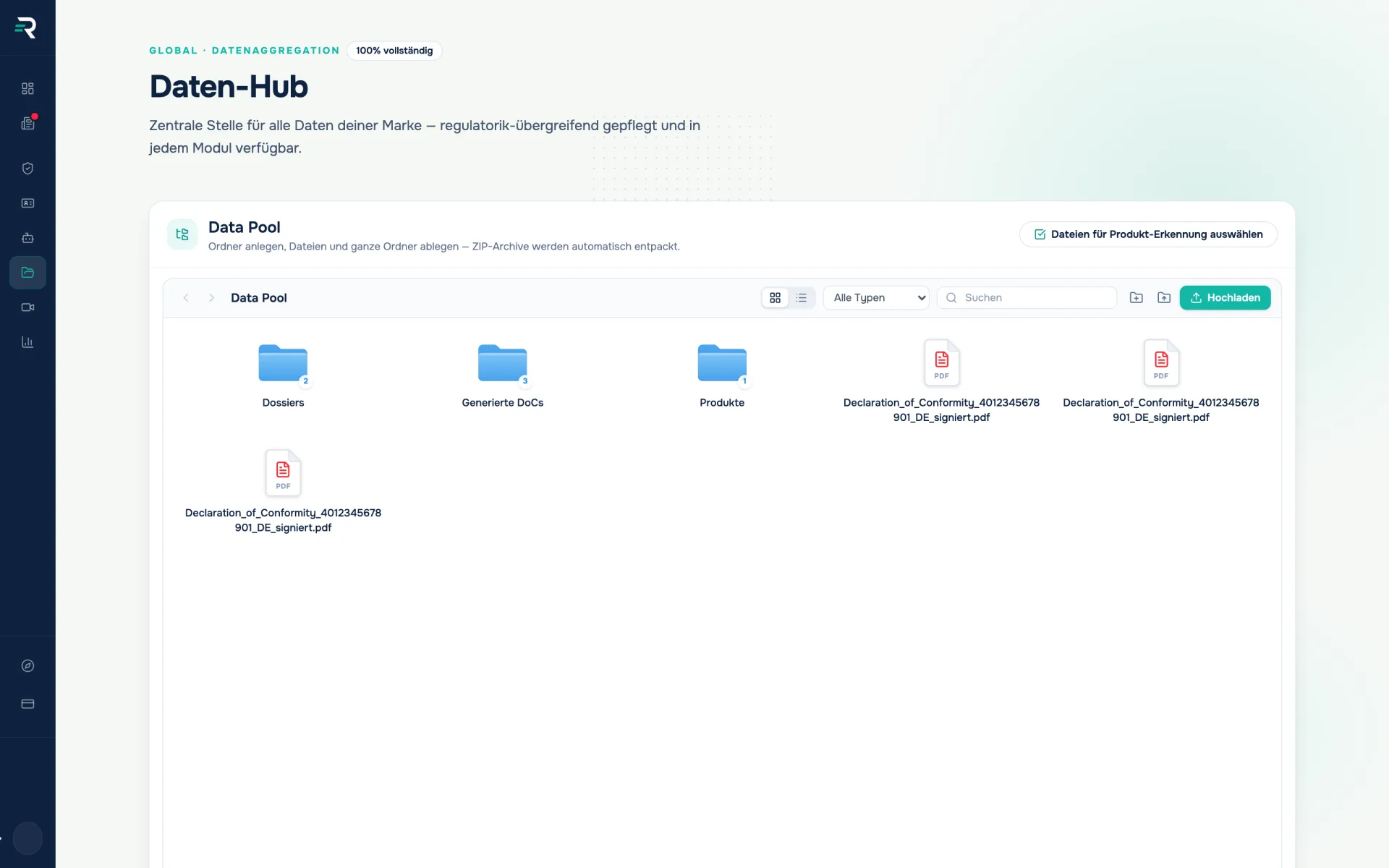
What has been released counts as present in the data hub. What is outstanding stays visible — and becomes the next request. Data collection is therefore not a project but a loop attached to the completeness indicator.
An honest boundary
The extraction is a proposal, not a decision
Nothing is taken over before you have released it in the review — and a rejected proposal lives on nowhere. Whether the stated recyclate share is plausible and the attached certificate holds up is your call. What the automation takes over is the retyping and the matching — not the responsibility.
How it fits together
One set of data that carries forward
01
Product master data
says which component needs a value
Packaging component · Material class · open data point
02
Supplier requests
collects the value from the supplier
Template with article reference · released value · Attachments
03
Data hub
brings the result together and evidences its provenance
Completeness state · Source
Frequently asked questions
Does the supplier get access to Reguly?
No. The supplier receives a structured email and replies by email or attachment — without an account and without a portal login. Reguly’s invitation link belongs to the internal team invitation flow for your own staff, not to suppliers.
What happens if a supplier does not reply?
Requests open for more than seven days appear in the supplier list as overdue. From there you send a targeted reminder or resend the request.
How reliable is the automatic evaluation of the reply?
It supplies a proposal with a confidence score. You check it in the review and release or reject it — nothing is taken over unchecked.
Where do the values that come back end up?
After release, in the responsible specialist module — recycled content, restricted substances and PFAS, or the material details of the declaration of conformity. The data hub then shows them as present with the source “data request”.
Regulation (EU) 2025/40 (PPWR), Art. 5, 7, 39 and Annex VIII
Reguly templates: material composition (Annex I / DoC), recycled content (Art. 7), restricted substances and PFAS (Art. 5)
Passt dazu
Every value knows where it came from.
The data hub brings together all packaging data across sources, shows the completeness rate and makes it traceable where every value came from.
Every PCR value with provenance, evidence and expiry date.
Record and evidence PCR shares per packaging component and check them automatically against the minimum targets for 2030 and 2040 — with certificate, supplier and expiry.
The regulation, broken down into 20 obligations.
The compliance roadmap breaks the PPWR down into 20 obligations by deadline — with legal basis, your status read from your packaging data and the steps still missing in Reguly.
First know what is missing
Five questions show you which details your PPWR evidence needs — and which of them sit with your suppliers.