

PPWR Art. 7
Every PCR value with provenance, evidence and expiry date.
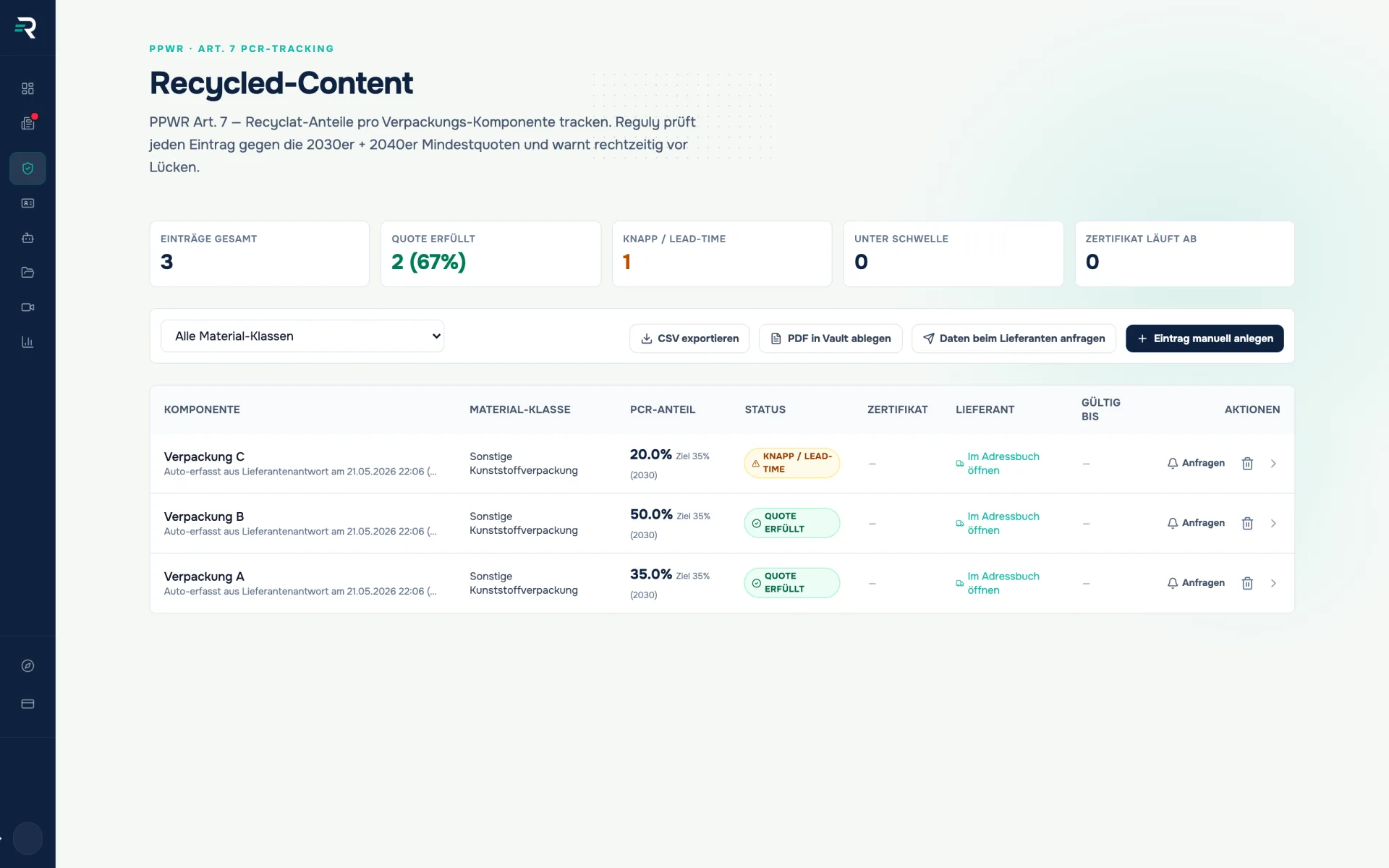
Reguly tracks the recyclate share per packaging component, assigns it to one of the four material categories from Art. 7 and checks it against the targets for 2030 and 2040.
- Legal basis
- PPWR Art. 7, Annex II
- Material categories
- 4
- Targets from 2030
- 30 / 10 / 30 / 35 %
- Targets from 2040
- 50 / 25 / 65 / 65 %
Ausgangslage
The real recyclate share is known to your supplier, not to your company
Art. 7 requires a minimum share of post-consumer recyclate in every plastic part — to be evidenced under Annex VII. But the value is created far upstream of your filling line, at the material producer. And it is not a constant.
- Post-consumer means post-consumer: offcuts from your own production do not count — a confusion that renders a whole chain of evidence worthless.
- PCR shares vary by batch. A value without a validity period is, in an audit, a value without meaning.
- Certificates sit as PDFs in the purchasing inbox, the percentage in a spreadsheet with packaging — and nobody notices when one expires.
Zeitachse
Why 2030 is already a data problem today
The hard targets only bite in 2030 — before them lie the dates that decide how the calculation is done. Before 2030 Reguly sets the applicable threshold to zero but already aligns its warning with the 2030 target.
by 31 December 2026
The calculation method arrives
The implementing act on the calculation and verification method (Art. 7(8)); it applies from 2029 (para. 11). Until then there is no EU-wide calculation rule — but there is an obligation to build the data base.
1 January 2030
First minimum targets
30 per cent for contact-sensitive PET packaging, 10 for contact-sensitive packaging from other plastics, 30 for single-use beverage bottles, 35 for all the rest (Art. 7(1)). What counts is the average per manufacturing plant and year.
1 January 2040
The targets rise
The same four categories, new values: 50, 25, 65 and 65 per cent (Art. 7(2)). For two of them almost a doubling — with lead times that belong in the material decisions you make today.
How you work with it
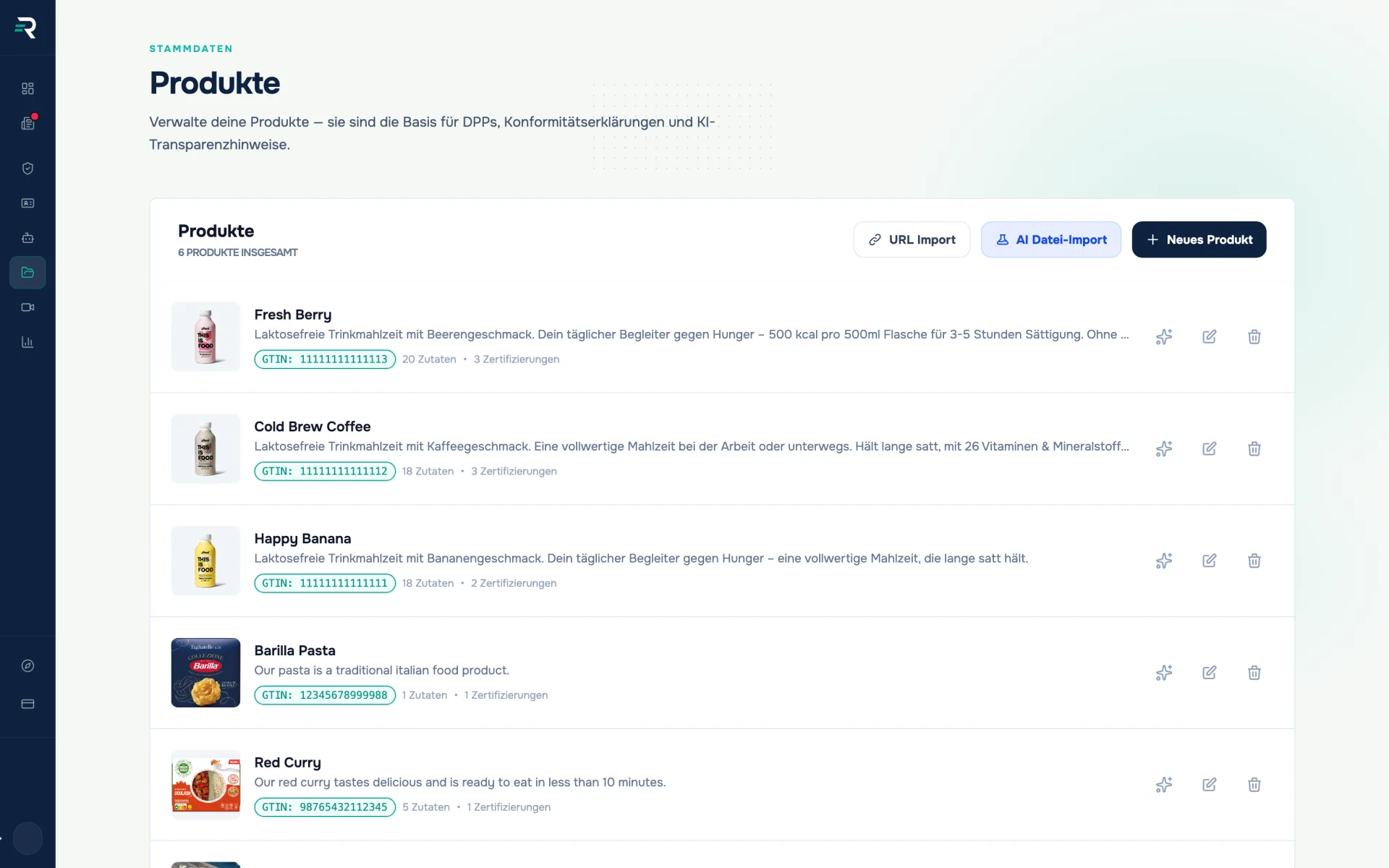
Pull the components from the master data and categorise them
The PCR share hangs off the individual component, not the product. The list of plastic parts comes from the master data; you assign each of them to one of the four material categories from Art. 7. The category drives everything else — it determines the applicable target.
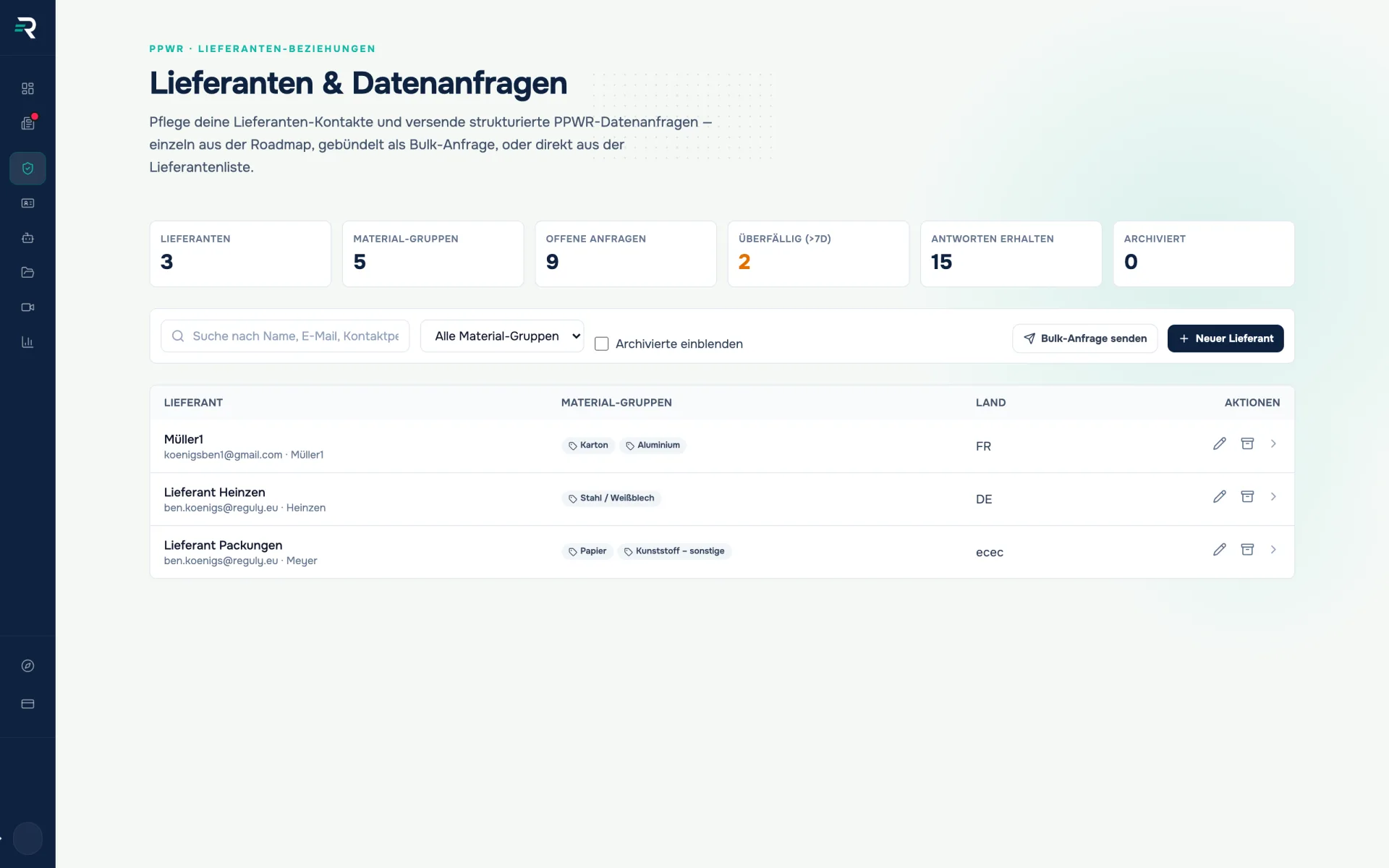
Ask the supplier for the value instead of estimating it
In its empty state Reguly explicitly advises against estimating PCR values — only your material supplier knows them. The request goes out structured: PCR share, recycling method, certificate. The supplier replies into a form, not into an email.
The reply becomes the entry — with evidence and validity
The reply becomes the entry: component, material category, recycling method, PCR share, certification scheme, supplier and validity period. Available schemes are EuCertPlast, ISCC PLUS, RecyClass, REDcert², CertiPlast and Bureau Veritas RCS. Next to the percentage field, a badge shows the gap to the next target as you type.
Read the status, work through the gaps, file the evidence
Every row carries one of three statuses: target met, close, or below threshold; the same values appear as figures above. If a certificate expires in less than 60 days, the module highlights the date. The CSV export carries status, thresholds and deadlines with it, and the PDF report moves into the vault with versioning.
How it fits together
One set of data that carries forward
01
Data hub
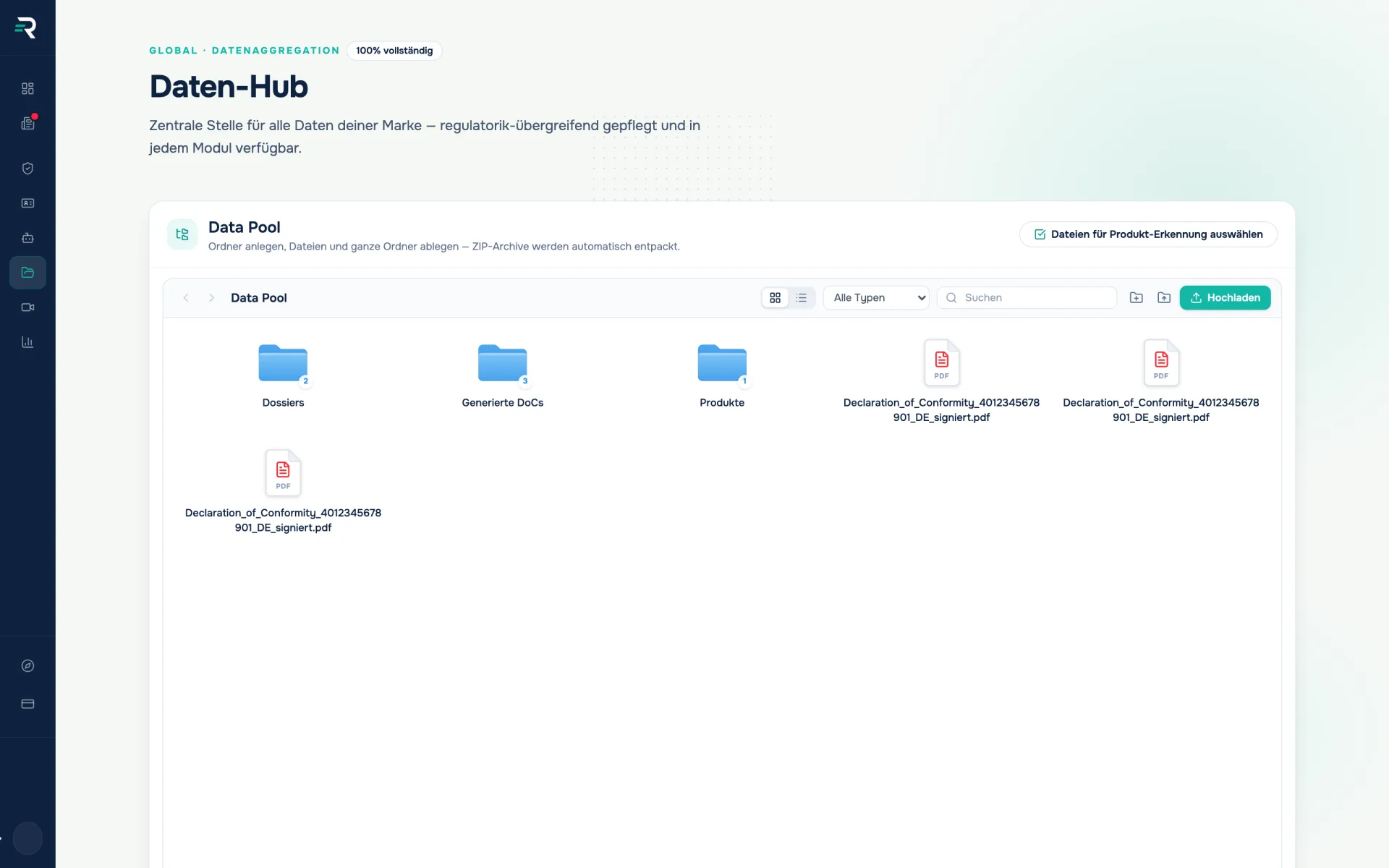
collects the value from the supplier in a structured way
PCR share · Recycling method · Certificate
02
Recycled-content tracking
assigns it to the material category and checks it against the target
Material category · Status · Validity
03
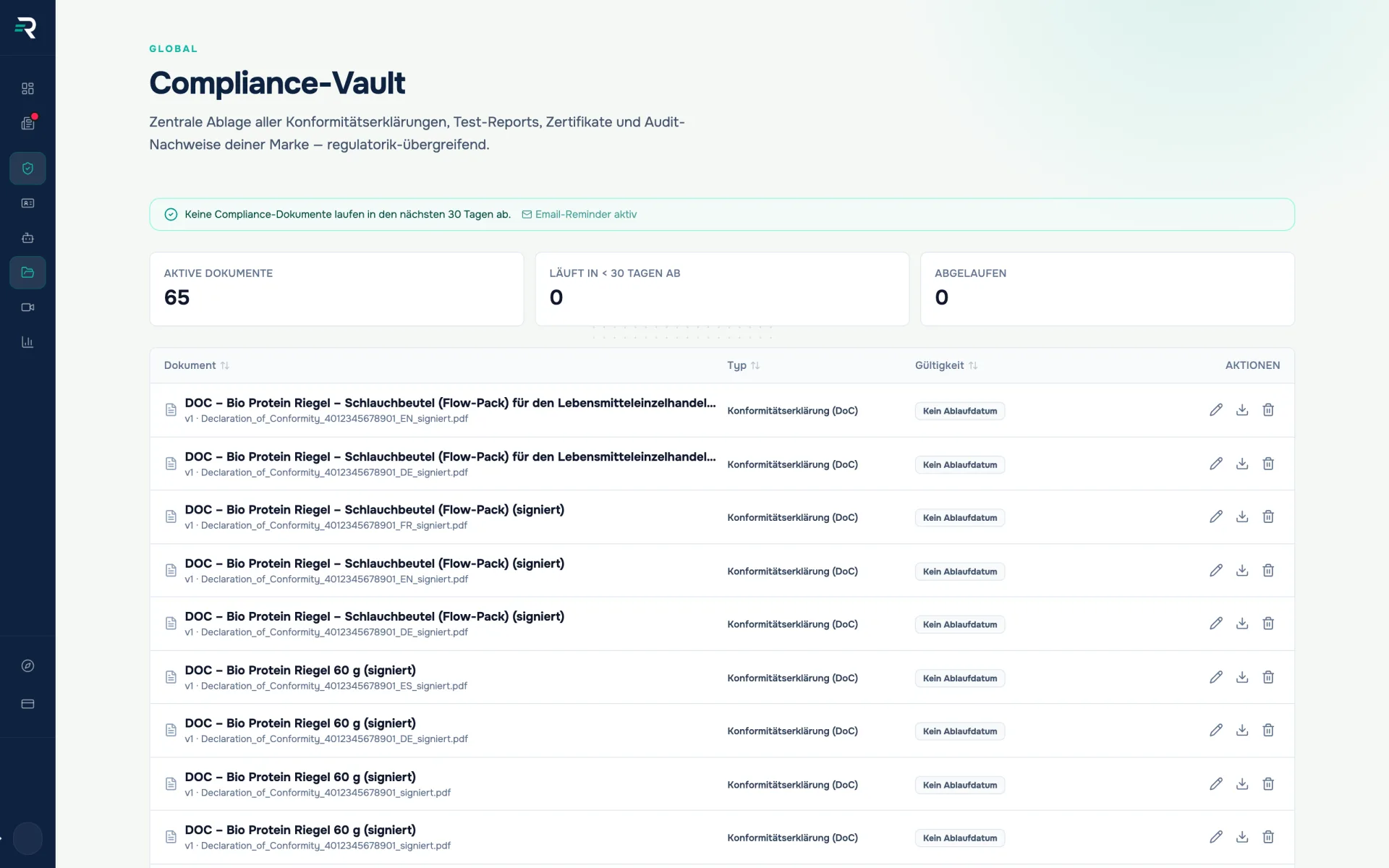
Compliance vault
keeps the certificate and PDF report with versioning
Certificate file · PDF report
04
DoC generator
takes the evidenced share into the declaration of conformity
Recyclate figure
Frequently asked questions
Does production waste count towards the target?
No. Art. 7 means post-consumer recyclate only, that is material from the recovery of consumer plastic waste. Pre-consumer offcuts from your own production do not count. Only enter the value your supplier declares as post-consumer in the “PCR share” field.
Does every single piece of packaging have to reach the target?
No. What counts is the average per plastic part, packaging type and manufacturing plant per year (Art. 7(1)). The module keeps the individual evidence per component; the binding average calculation under the EU method stays with you.
What does the status “Close / lead time” mean?
That a value is less than 5 percentage points below the applicable threshold — or meets the current target but comes just as close to the next milestone. The buffer is an early warning, not a legal tolerance.
Are there packaging types the target does not apply to?
Yes. Art. 7(4) exempts, among others, primary packaging for medicinal products, contact-sensitive packaging for medical devices, compostable plastic packaging and dangerous-goods packaging; under para. 5 additionally plastic parts below 5 per cent of the total weight. The classification remains your decision.
Passt dazu
Every value knows where it came from.
The data hub brings together all packaging data across sources, shows the completeness rate and makes it traceable where every value came from.
Every substance value knows its limit.
Reguly records PFAS, heavy metals, SVHCs and bisphenols per packaging component, checks every value against the thresholds and makes the evidence audit-ready.
The volume report grows out of your packaging.
Calculate packaging volumes from your master data, break them down by the eight LUCID material types and system operator, and generate the XML for upload to LUCID.
First know, then calculate
Five questions show you which PPWR duties apply to your range and which deadline comes first — free and without signing up.