

Data & suppliers
Every substance value knows its limit.
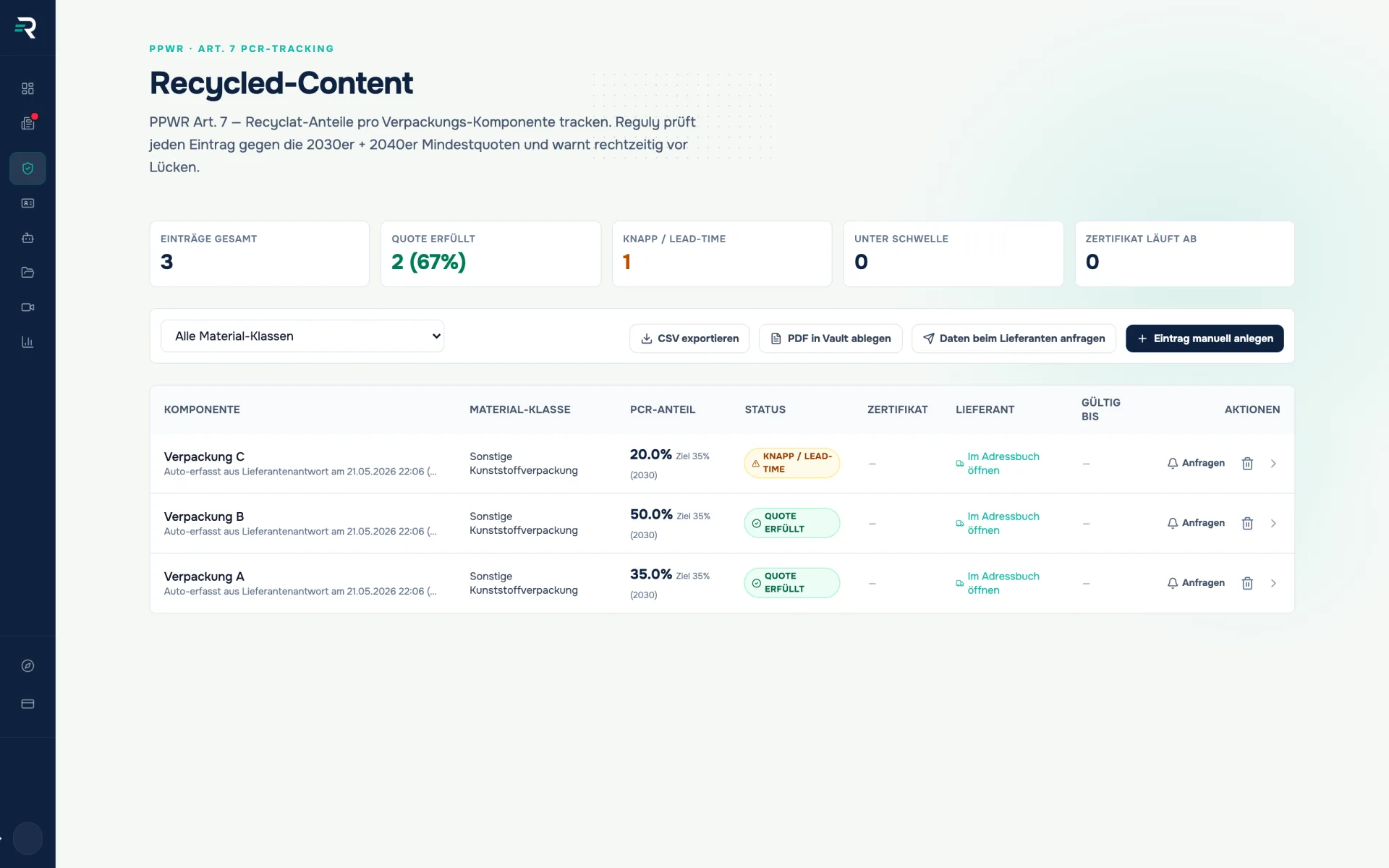
Record PFAS, heavy metals, SVHCs and bisphenols per packaging component — with test method, certificate and validity. Reguly compares every value against the stored threshold and warns before it gets tight.
- Regulation
- PPWR (EU) 2025/40
- Context
- Art. 5, Annex VII
- Substance classes
- PFAS, heavy metals, SVHC, bisphenols
- Key date
- 12 August 2026
Ausgangslage
Your supplier knows the values — you have to evidence them
Art. 5 PPWR restricts substances of concern: from 12 August 2026, PFAS limits for food-contact packaging, plus a combined limit for four heavy metals. Measuring happens in a laboratory. Evidencing it is on you.
- Test reports sit as PDFs in an inbox — which component they relate to is known only to whoever requested them.
- ppb and ppm get confused. Between 250 ppb and 50 ppm lies a factor of 1,000.
- Without evidence, conformity counts as undemonstrated — even when the packaging is clean.
How you work with it
Determine the critical components
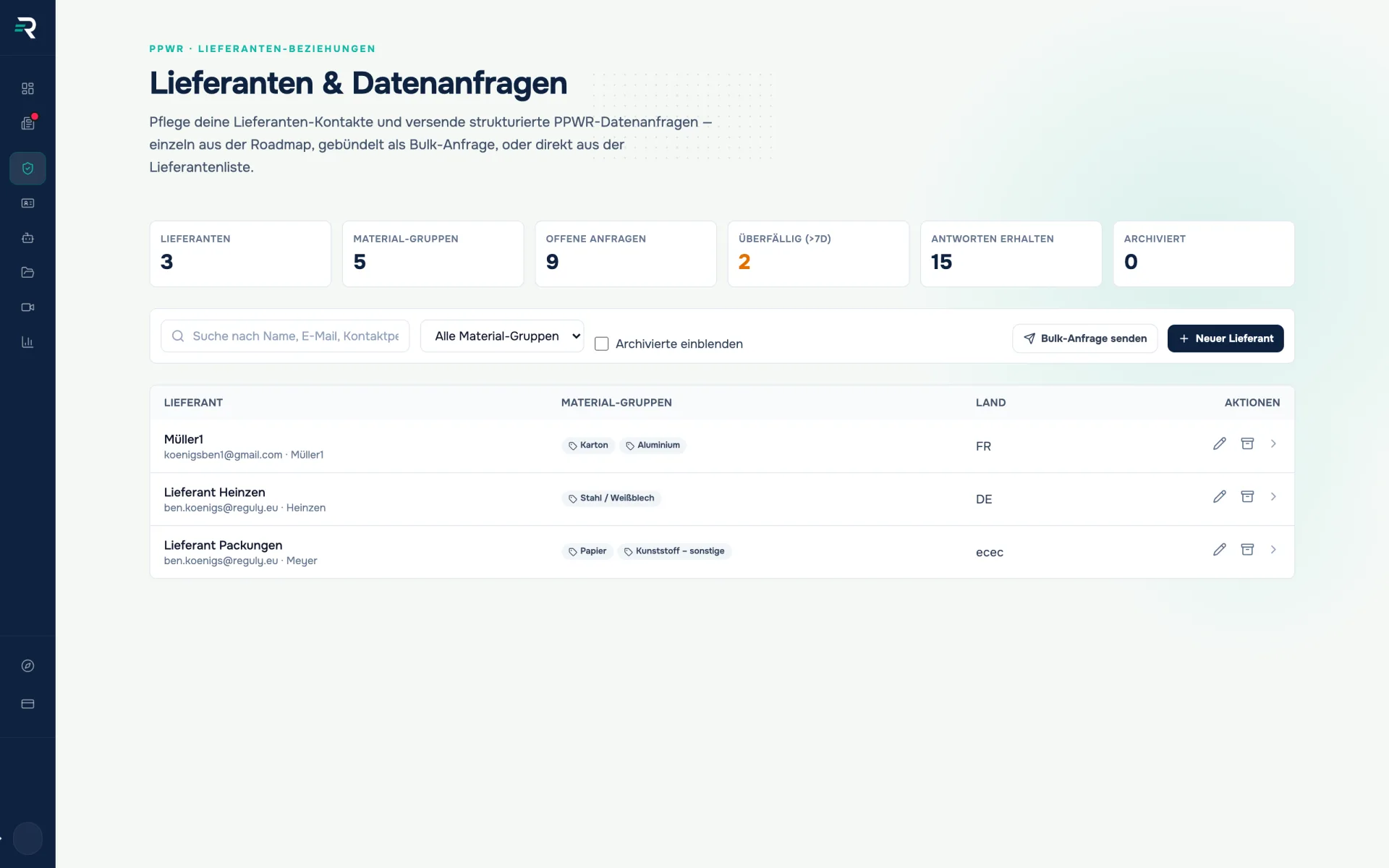
The PFAS limit from Art. 5(5) applies to food contact, the combined heavy-metal limit from para. 4 to all packaging. In the master data every component hangs off its product — from that follows what you have to have tested: coatings, printing inks, films.
Request the values from the supplier
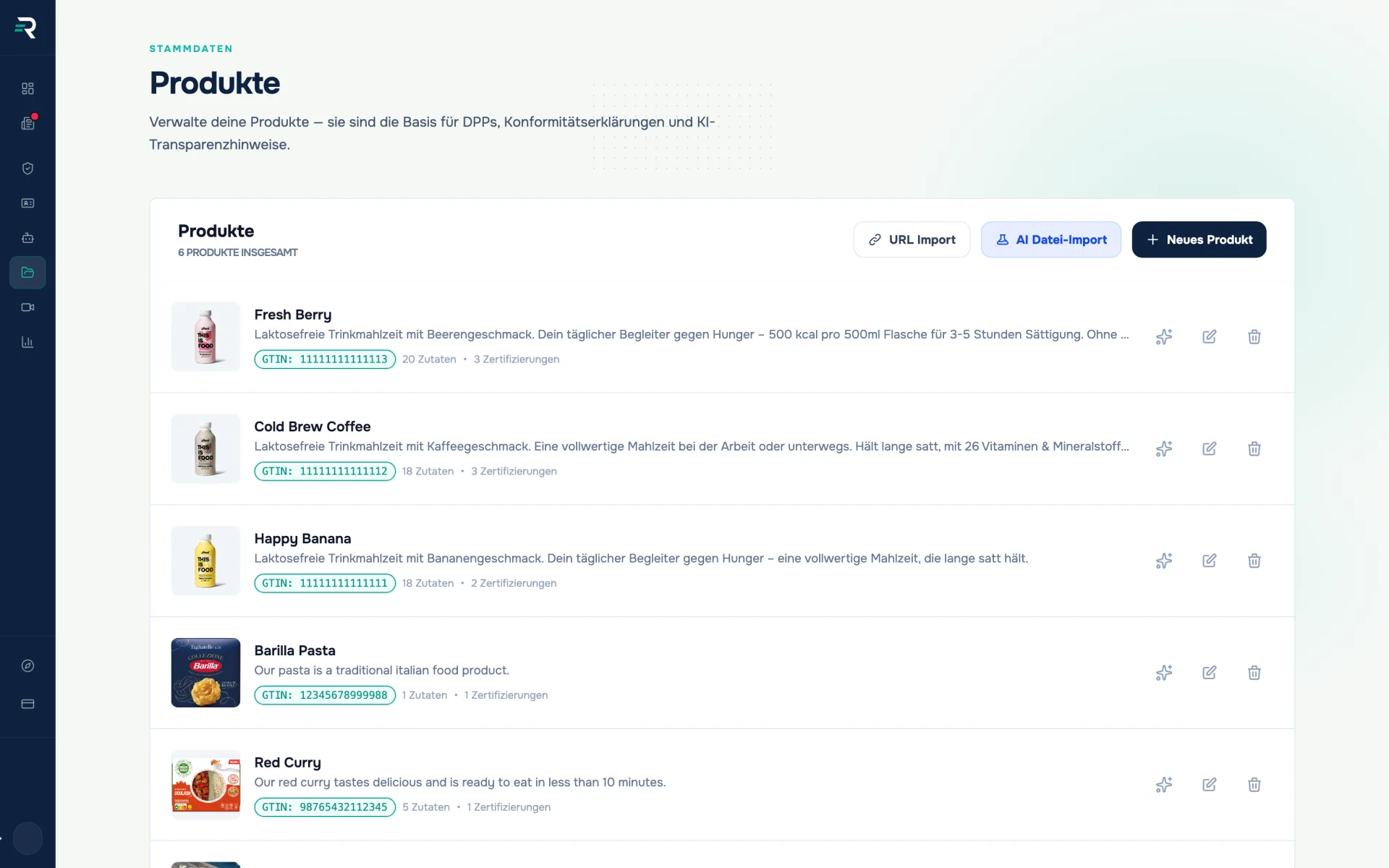
The analyses sit with the material supplier. A structured request goes out via the substance-restriction template — a form with defined fields per substance rather than a free-form email. A phone call becomes a documented case.
Create the entry and assess it
Per substance and component one row is created: substance class, substance name, CAS number, concentration, test method, certificate, supplier and validity. From concentration and threshold Reguly derives the status — below, close or exceeded. “Close” means: less than ten per cent margin, an early warning and not a legal buffer.
File the report and evidence it
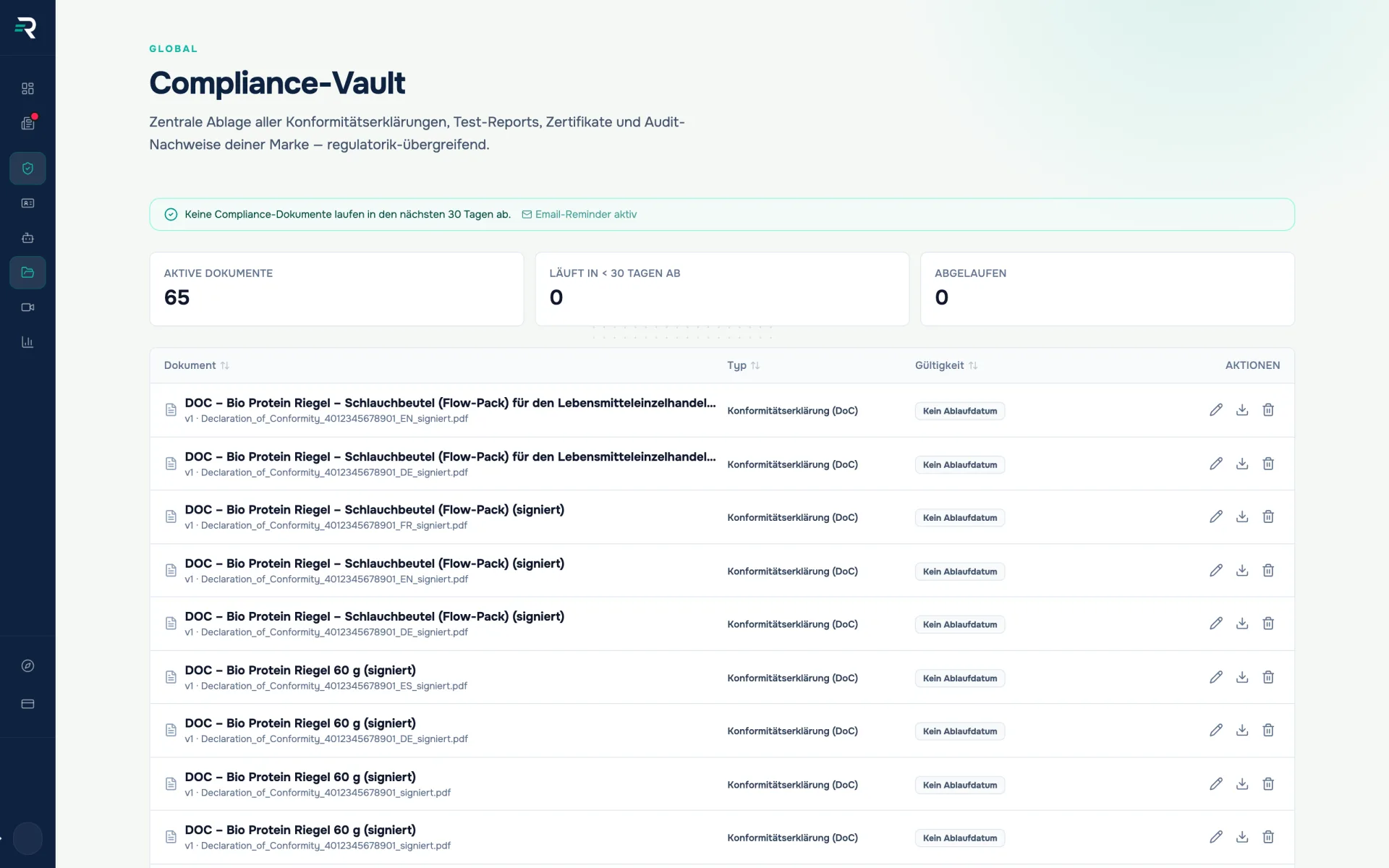
The CSV export delivers the table including the margin in per cent. “File PDF in vault” produces the audit-ready report and files it in the vault with versioning — together with the underlying test reports. The evidence under Art. 5(6) then sits where the rest of the technical documentation lives.
Food & packaging
Your coated or printed materials are in food contact — that is where the PFAS limit bites first.
Compliance & quality
You bring analyses, supplier declarations and test reports together into evidence that survives an audit.
Purchasing
You need an early signal about which component is heading over the line — before a batch is standing there and switching supplier takes months.
How it fits together
One set of data that carries forward
01
Supplier requests
collects analyses and declarations in a structured way
Concentration · Test method · Test report
02
Substance & PFAS management
assesses every value against the stored threshold
Status · Margin in per cent · Validity
03
Compliance vault
keeps the report with versioning as Annex VII evidence
PDF report · Version
04
DoC generator
takes the substance declaration into the declaration of conformity
Substance declaration
Frequently asked questions
Does Reguly measure my packaging?
No. Reguly is not a testing laboratory and does not replace one. Measuring happens at your site or at your supplier’s; Reguly records the values, assesses them against the thresholds and organises the evidence trail. The legal interpretation stays with you.
Which PFAS limits apply from 12 August 2026?
For food-contact packaging, Art. 5(5) names three cumulative thresholds: 25 ppb per individual targeted PFAS, 250 ppb for the sum of targeted PFAS and 50 ppm for total PFAS including polymeric ones. Any of them can bite.
What is the difference between ppb and ppm?
ppb means parts per billion, ppm parts per million — a factor of 1,000 between them. The targeted PFAS values are given in ppb, the total value in ppm. This is the most common arithmetic mistake in this area.
Does the heavy-metal limit apply per substance or as a sum?
As a sum. Lead, cadmium, mercury and hexavalent chromium together must not exceed 100 mg/kg (Art. 5(4)). Thinking of them individually is how four unremarkable values end up jointly over the line.
Passt dazu
Every value knows where it came from.
The data hub brings together all packaging data across sources, shows the completeness rate and makes it traceable where every value came from.
Every piece of evidence is ready, none expires quietly.
The compliance vault keeps every piece of evidence in one place — test reports, certificates and declarations, versioned and with expiry monitoring.
The data sits with the supplier. Collect it in a structured way.
Maintain suppliers, send ready-made PPWR data requests as a campaign, have replies evaluated automatically and release them after review — all in Reguly.
Do you know what is in your packaging?
Five questions show you how far your PPWR evidence carries you — free and without signing up.