

PPWR
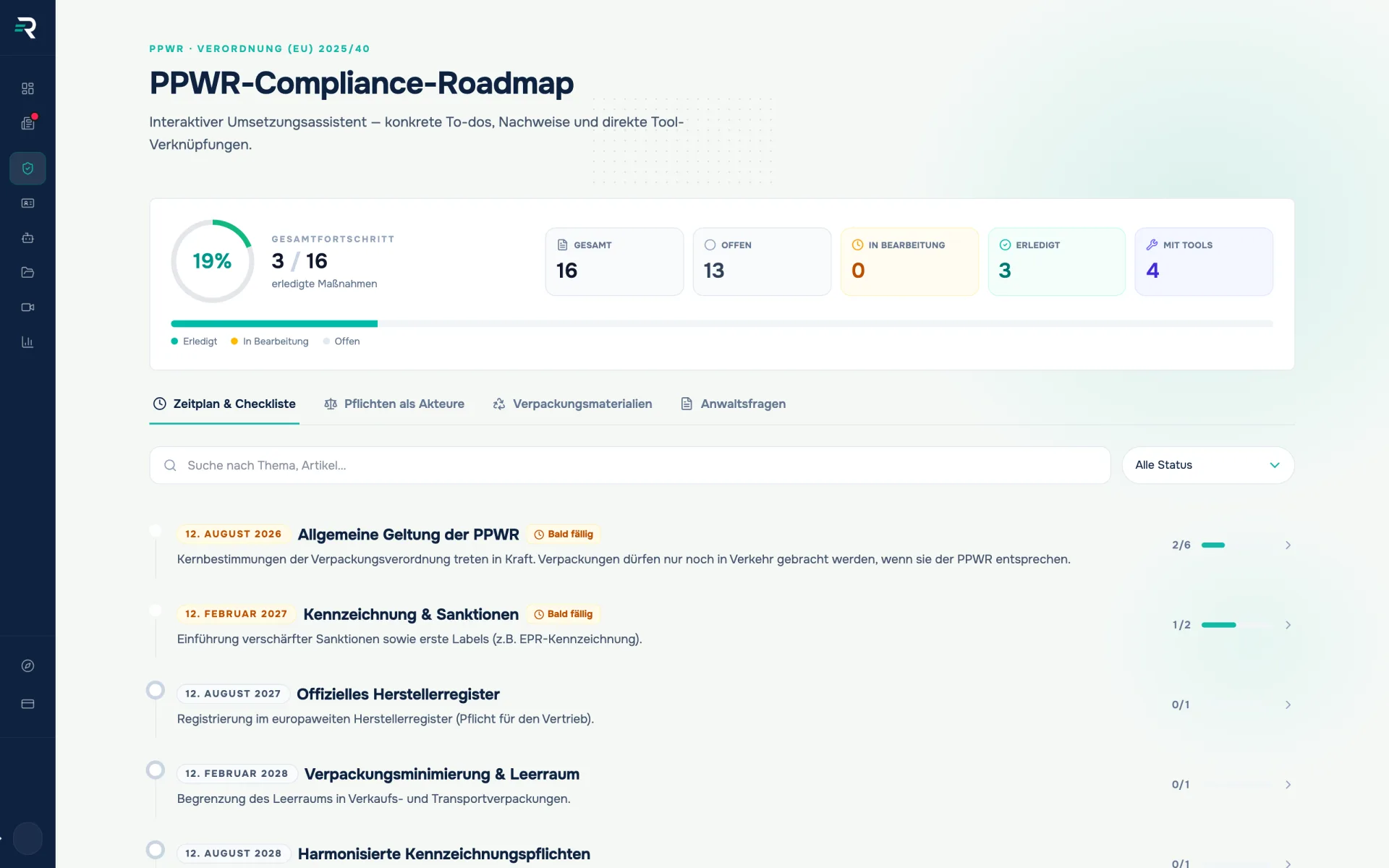
The regulation, broken down into 20 obligations.
Seven deadlines from August 2026 to 2040 — every obligation with its legal basis, your status from the packaging data and the module where you get it done.
- Regulation
- PPWR (EU) 2025/40
- Date of application
- 12 August 2026
- Deadline stages
- 8, through 2038/2040
- Obligations
- 20
Those placing on the market
You need to know what applies to your range from 12 August 2026.
Compliance & quality
You need a picture that shows what is done and what is still open.
Consultants & law firms
You get your clients’ open questions in one bundle instead of one email at a time.
Ausgangslage
The regulation does not tell you what to do on Monday
The PPWR applies directly in every member state — there is no national implementing act left to wait for. The text names duties and deadlines, but no order of play, no ownership and no list of evidence.
- The deadlines are spread across articles and annexes — 12 August 2026 is only the date of application, many detailed values do not bite until 2030.
- Who inside the company supplies which figure is written nowhere: data sheets sit with the supplier, weights with logistics, claims with marketing.
- Open legal questions pile up in email threads instead of arriving at the law firm in one bundle.
Zeitachse
What applies when — and why the date of application is not the end
The roadmap carries seven deadlines; these four span the arc. In between sit penalties (February 2027), national producer registers (expected August 2027), compostability and void space in sales packaging (February 2028) and harmonised labelling (August 2028). Anything due in less than a year is marked amber, anything already in force dark blue.
11 February 2025
Entry into force
Twenty days after publication in the Official Journal (Art. 71). As a regulation, the PPWR applies directly — without a national implementing act.
12 August 2026
Date of application
The bulk of the regulation bites and Directive 94/62/EC is repealed. From here on, packaging may only be placed on the market if it complies with the PPWR (Art. 4(1)). Seven obligations hang on this date, from the declaration of conformity to the packaging register.
1 January 2030
The core stage
Recyclability by class, minimum recycled content, the empty-space ratio and packaging minimisation take effect (Art. 6, 7, 10, 24) — subject to the legal acts still to be adopted on each.
1 January 2038
Class A or B only
Packaging in recyclability class C loses market access (Art. 6(3)); two years later the tightened recycled-content stage follows (Art. 7(2)) — lead times that belong in the material decisions you make today.
What matters most
Your status comes from your data, not from checkboxes
Every obligation reads its status from what is maintained in Reguly anyway: how many packaging have a declaration, how many dossiers are complete, which components sit in grade D or E, whether last year’s LUCID report was submitted. A click opens the obligation with explanation, deadline and transition rule, the steps in Reguly and what stays outside, plus the legal basis with article and wording. The role check places you as manufacturer or producer and dims what does not apply to you. Whatever does not fit your range you mark as “not relevant”; legal questions remain as their own tab.
How it fits together
One set of data that carries forward
01
Compliance roadmap
orders the duties and sets the dates
Status per obligation · Deadline · Legal basis
02
Supplier requests
fetches the evidence a task calls for
Material data sheet · Lab analysis · Certificate
03
DoC generator
turns it into the declaration of conformity
Declaration of conformity
Frequently asked questions
Where do the deadlines in the roadmap come from?
From the text of Regulation (EU) 2025/40 — seven deadlines from general application in 2026 to the tightening from 2035 to 2040. Many detailed duties additionally depend on Commission acts; the roadmap therefore states the caveat per deadline and quotes the articles instead of promising anything.
What do the four statuses mean?
Open, In progress, Done and Not relevant. You set them in the detail panel; the state is saved and is there again next time you open it, as is your note per obligation. Obligations that do not fit your range, such as reusable or compostable packaging, are taken out of the progress with “Not relevant”.
Does Reguly calculate my status automatically?
Where the data allows, yes. For eleven of the twenty obligations Reguly reads the status from your packaging, dossiers, the substance and recycled-content registers and the packaging register — for example “7 of 9 packaging with declaration” or “2 components in grade D”. You still tick “Done” yourself, because Reguly cannot see what is printed on the packaging.
What happens to the legal questions?
You store your law firm’s contact details and your questions, then send them individually or in one bundle. The reply lands on the item together with its attachments, after which you mark it as resolved. The legal assessment stays where it belongs.
Passt dazu
DoC generator
The reviewed data becomes a finished declaration of conformity.
The volume report grows out of your packaging.
Calculate packaging volumes from your master data, break them down by the eight LUCID material types and system operator, and generate the XML for upload to LUCID.
A new obligation? It is already in your inbox.
Regulatory changes on the PPWR, the DPP and the AI Act land filtered in your inbox — summarised in plain language, with concrete next steps.
Know what comes first
Five questions show you which PPWR duties apply to you and which deadline arrives first — free and without signing up.