

Digital Product Passport
A QR code that never has to be reprinted.
The code points at the GTIN, not at a version. You change the passport content — the packaging on the shelf stays as it is.
- Legal framework
- ESPR (EU) 2024/1781
- Context
- PPWR (EU) 2025/40, Annex VIII
- Public URL
- reguly.eu/p/<GTIN>
- ESPR product groups
- 11 in the roadmap
Ausgangslage
The passport rarely fails on content — it fails on the way to the packaging
Before a product passport reaches a person in a shop, it has to be generated, linked, printed and then maintained for years. That is exactly where it breaks.
- The QR code leads to a campaign page that will not survive the next website relaunch.
- If a detail changes, the packaging would have to be reprinted — so nobody changes anything.
- When the passport bites for your own product group is written in delegated acts, not in a calendar.
Zeitachse
The date depends on your product group
The ESPR introduces the product passport in stages. Reguly sorts your products by HS code into the eleven groups of the 2025–2030 working plan and shows the nearest date — including a marker wherever a date is only an estimate.
Since July 2024
The framework is in place
Regulation (EU) 2024/1781 creates the product passport as an instrument. What it has to contain per group, and from when, is set by delegated acts — still outstanding for most groups.
Today
Your products are sorted
Every product lands in one of the eleven groups, with the nearest date. Anything that matches no rule sits visibly under “Other” — with a prompt to add the HS code.
February 2027
Battery passport
The only date without an estimate marker: the battery passport follows the Batteries Regulation (EU) 2023/1542, not the ESPR. Anyone carrying batteries has the shortest lead time.
2027–2028, estimated
Textiles, tyres, furniture, steel and the remaining groups
Here the roadmap carries dates from the 2025–2030 working plan — each explicitly marked as an estimate, because the delegated act is missing. A date only becomes binding once that act is published.
How you work with it
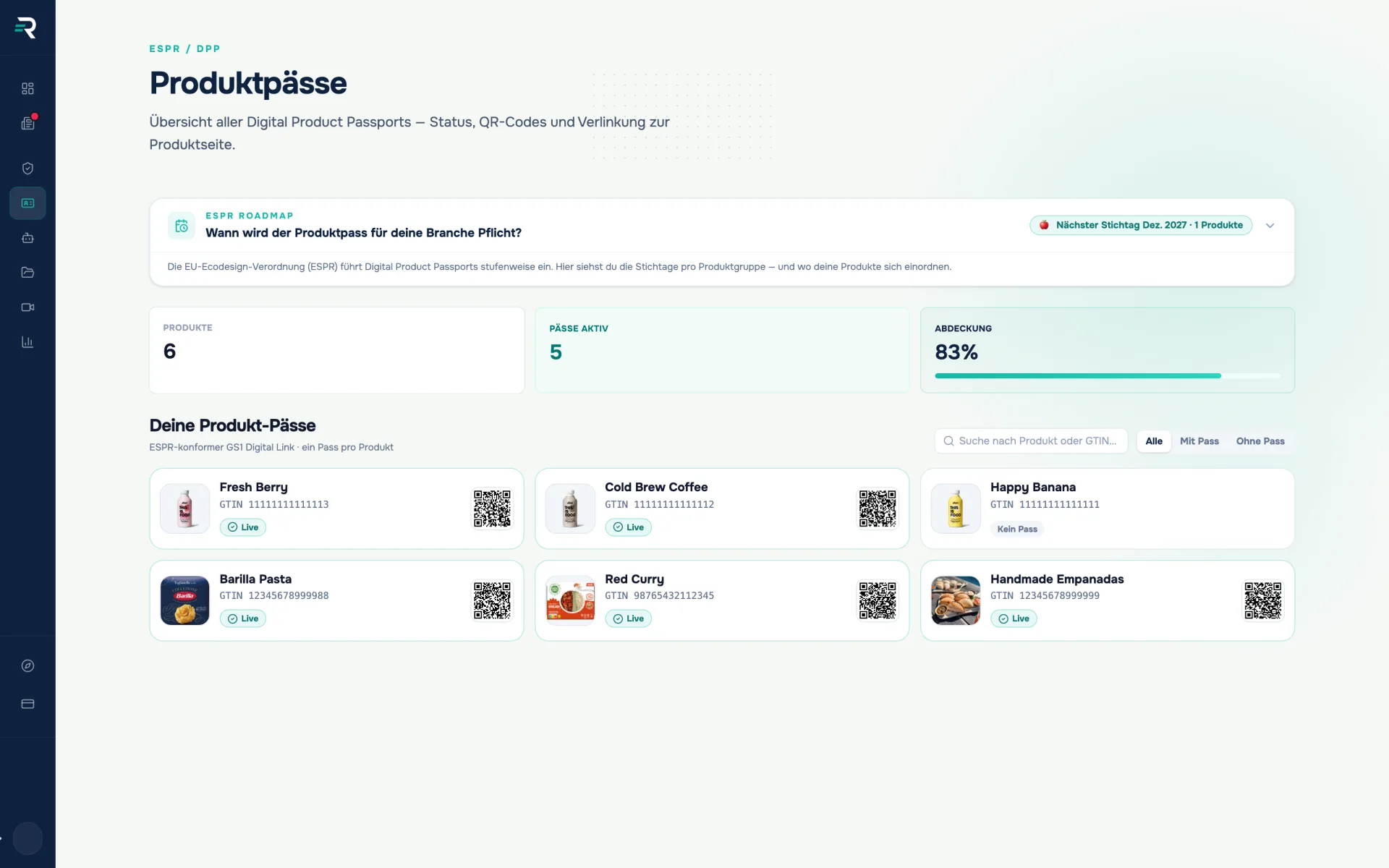
Create the passport
The DPP generator walks you through eight steps from identification to review, saves continuously as a draft and only publishes in the last step.
Set the GTIN, generate the QR code
The passport hangs off the GTIN: it is encoded and forms the public address. If it is missing, Reguly falls back to the internal product ID and marks the entry as a passport without a GTIN. One click generates the code, the tile flips to “Live” — and the coverage rate shows how many products have got that far.
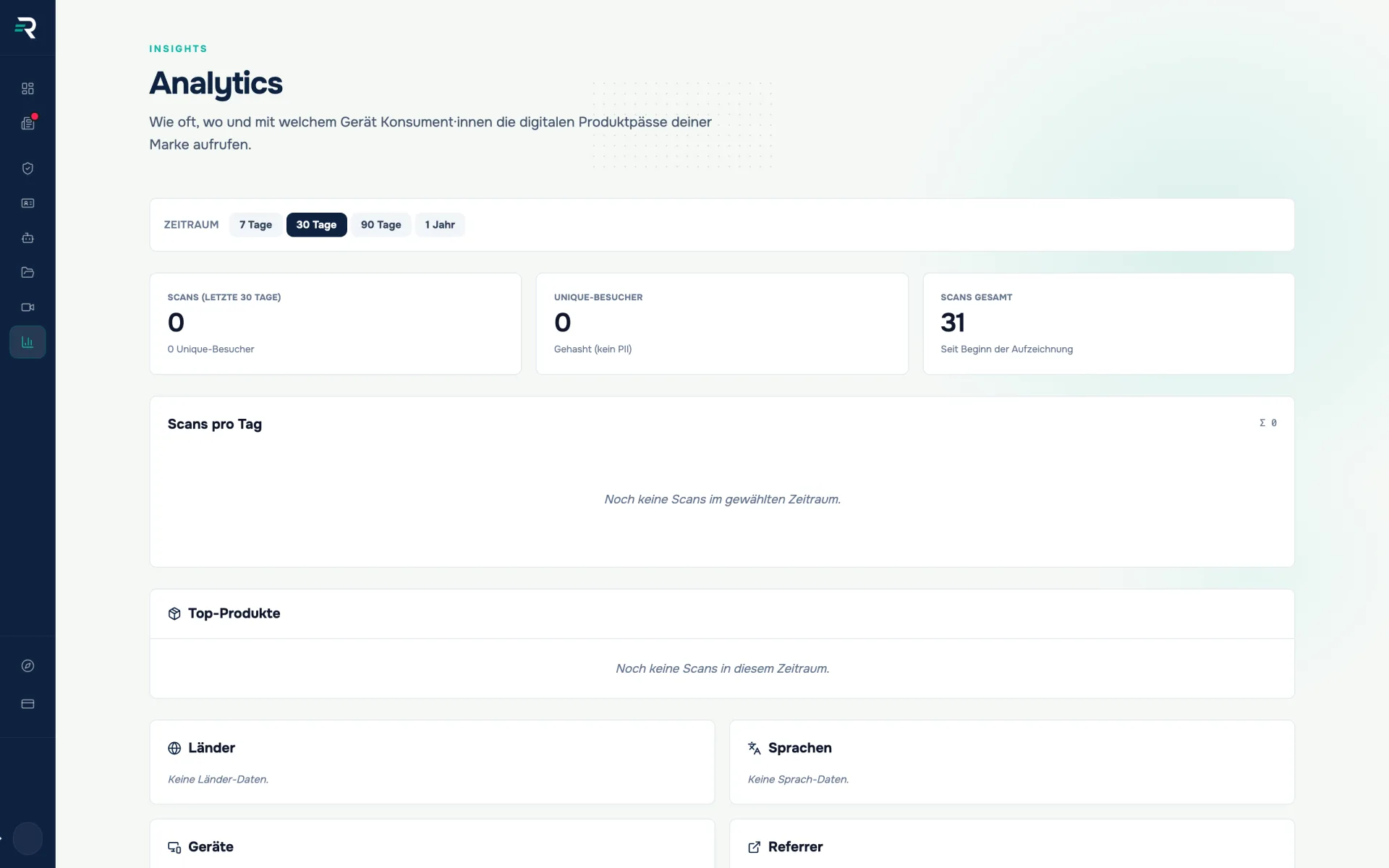
Evaluate scans
Every visit to the public page is counted. Analytics shows scans per day, top products, countries, languages, devices and referrers over selectable periods. Visitors are hashed — the analysis works without personal data.
How it fits together
One set of data that carries forward
01
Product master data
supplies identity and packaging
GTIN · Packaging components · Certifications
02
Product passports
turns it into passport, QR code and public page
QR code · public URL · coverage rate
03
DoC generator
draws the declaration of conformity from the same data
DoC under Annex VIII
Frequently asked questions
What is in the QR code?
The public address of the passport at www.reguly.eu/p/<GTIN>. If the product has no GTIN, the internal product ID takes its place.
Do I have to reprint if a detail changes?
No. The code points at the GTIN, not at a version. You update the content in the generator and the printed code stays valid.
Is the passport readable without JavaScript?
Yes. The public page is rendered server-side and embeds Schema.org JSON-LD — authorities, recyclers and crawlers reach the data without executing anything in a browser.
Can I also generate the PPWR declaration of conformity from here?
Yes, from the same product detail view. Reguly first checks which mandatory fields from Annex VIII are empty, names them with their annex point and leaves you the choice: complete them in the DoC generator, or knowingly generate with gaps.
Regulation (EU) 2024/1781 (ESPR) — framework for the Digital Product Passport
European Commission ESPR working plan 2025–2030 (priority product groups)
Regulation (EU) 2025/40 (PPWR), Annex VIII — declaration of conformity
Regulation (EU) 2023/1542 (Batteries Regulation) — battery passport from February 2027
Passt dazu
Eight steps, one draft, no blank form.
The DPP generator takes you in eight steps from the product name to a published Digital Product Passport — with auto-save and a check before release.
Every piece of evidence starts from the same product data.
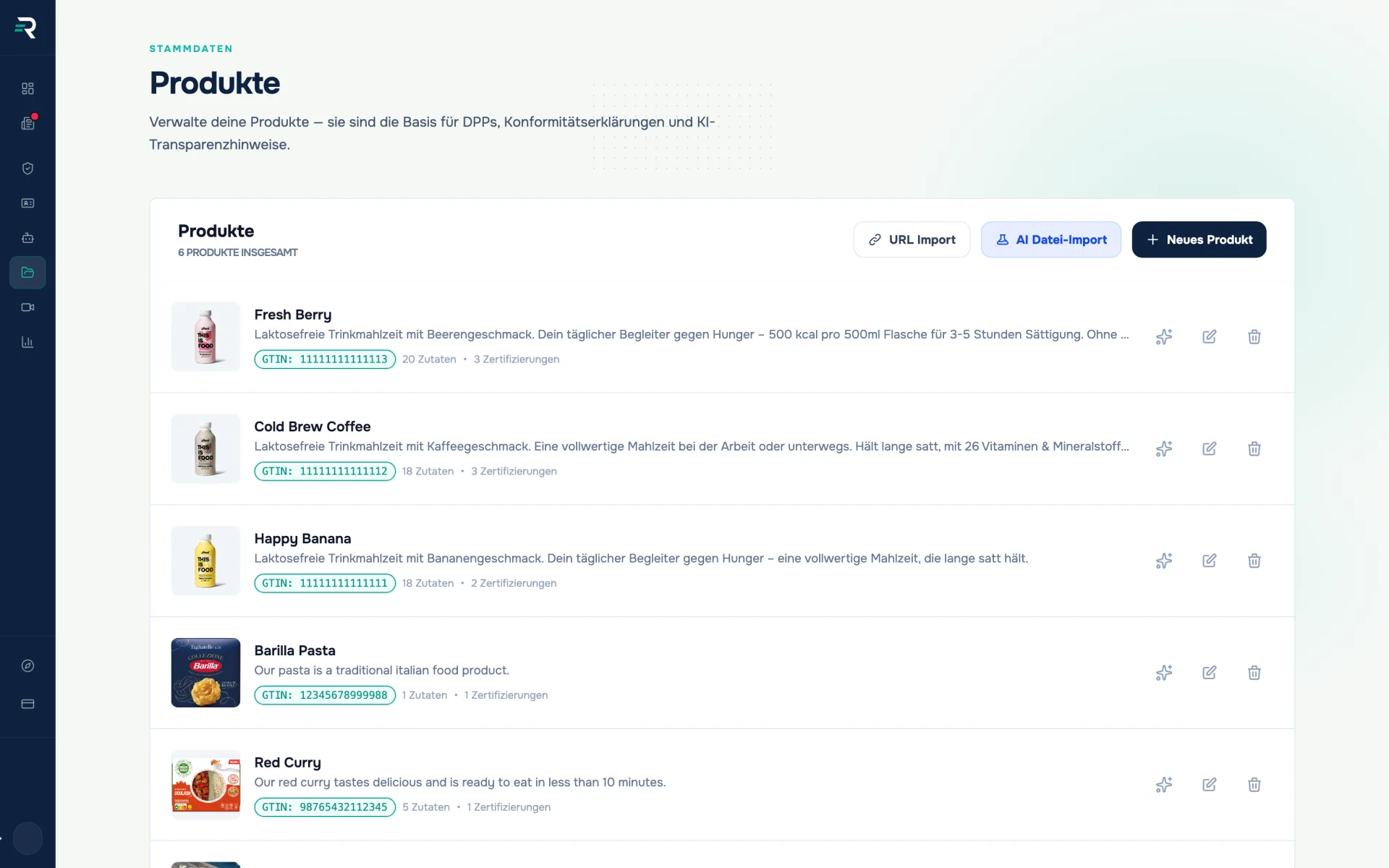
Maintain products, packaging components, GTIN and images once — the declaration of conformity, the product passport and the volume report all draw their values from it.
The passport is printed. Is it being opened too?
Analytics shows how often your digital product passports are opened — with a daily curve, top products and a breakdown by country, device and referrer.
Scan once instead of printing twice
We will show you on one of your products how the passport, the QR code and the public page fit together.