
Reguly

Data hub

Every figure knows where it came from.

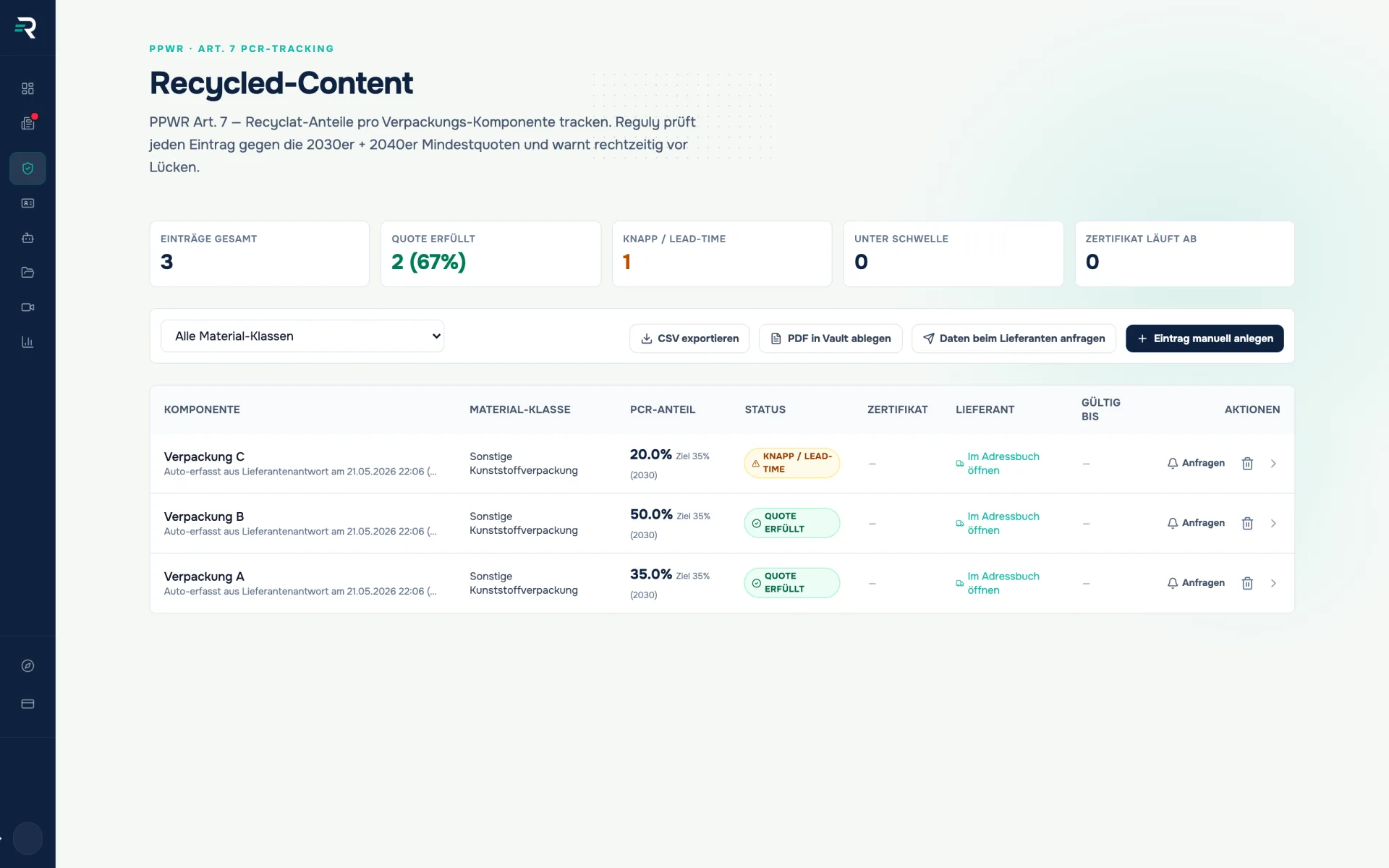
Material composition, recycled content and PFAS values sit with your supplier, not with you. The data hub gathers what every module produces, states completeness as a number, and records the source behind each individual value.

PPWR (EU) 2025/40 · Art. 5, 7, 39 and Annex VIII

Where you stand today

Your data already exists — in four places.

No PPWR project fails for lack of will. It fails because the same value sits in three spreadsheets in three states and nobody can say which one counts. The hub adds no fifth filing place, only a view across the four you have.

  1. In the ERP

    articles, weights, volumes

  2. With suppliers

    material, recyclate, PFAS

  3. In the inbox

    certificates as attachments

  4. In spreadsheets

    maintained, unevidenced

The hub reads what the modules already produce — it is not a second data-entry screen.

Completeness as a number, not a feeling

Opening the hub tells you how far along you are: available, pending, missing — per category and across the whole set. Filtering by status or source shows in one click what is holding things up.

More on the data hub
Reguly data hub: completeness across all categories, with data points marked available, pending and missing

One place for the documents you keep needing

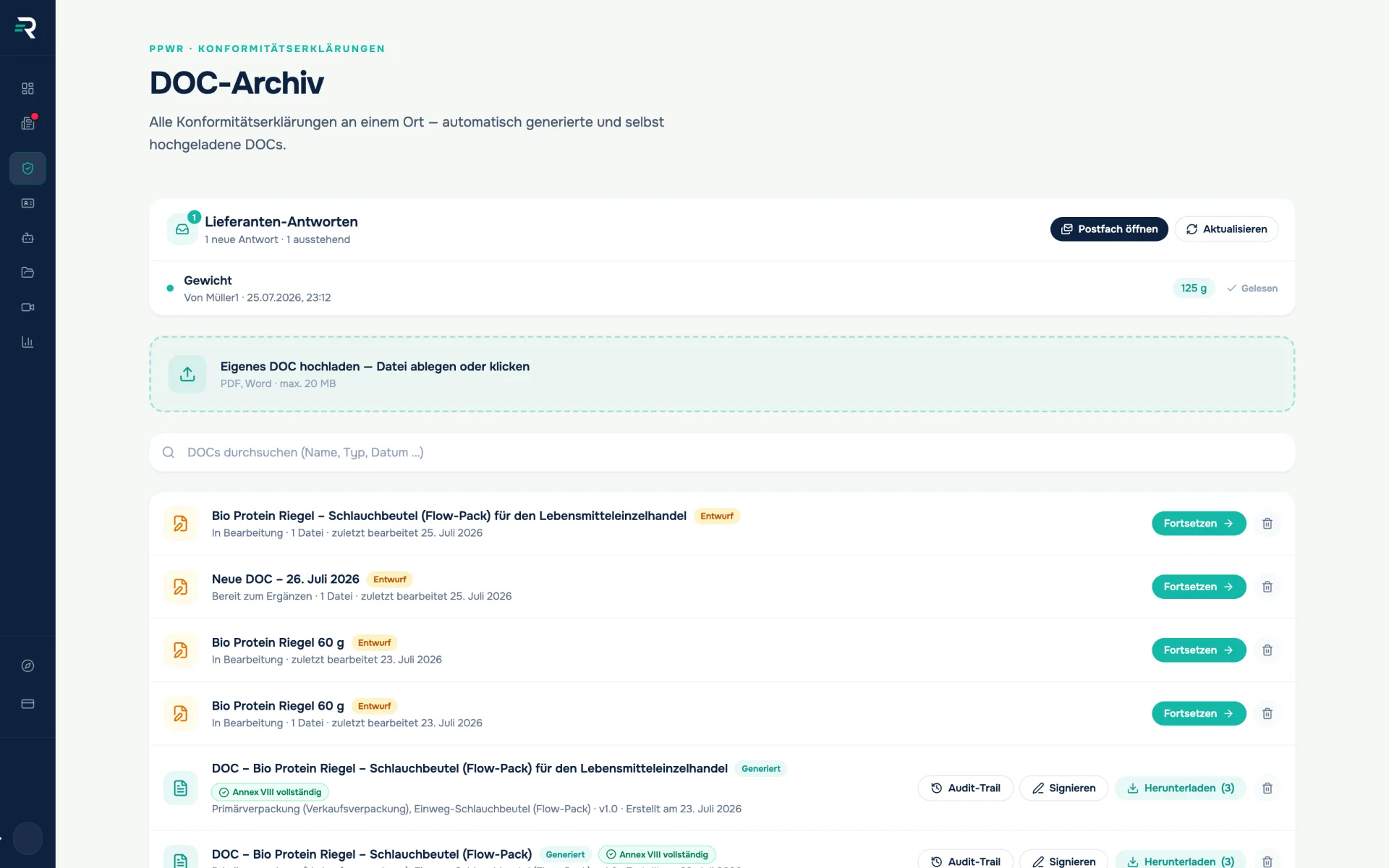
Certificates, standards and test reports otherwise get hunted down for every single case. In the data pool they sit once, in folders, linkable from any module — PDF, Excel, Word and images up to 20 MB per file.

More on the data pool
Reguly data pool: folders for certificates, technical data sheets and supplier replies with the stored files
Reguly data sources: connected systems with status active, mapping pending and error
Reguly supplier list with material groups and open data requests per supplier

Provenance over trust

In an audit it is not the value that counts, but its source.

A well-kept spreadsheet proves nothing. It holds numbers, but not where they came from, who entered them, or what stood there before. That is precisely what market surveillance asks about.

So in the data hub every single entry carries its source — DoC generator, data request, data pool, compliance roadmap, or entered by hand. Where a history exists, the approved states remain viewable, with date and sender.

Reguly data points, each row carrying its source badge: packaging type from the DoC generator, recycled content from a supplier reply, certificate from the data pool, article count from the compliance roadmap, plus one pending and one missing value
  • Five kinds of source, stated per value rather than per spreadsheet.
  • Approved states stay viewable — even after a value has been overwritten.
  • Pending requests are visible as pending, not disguised as gaps.
  • Evidence documents hang off the value, not in a separate folder.
Read the data hub documentation

Demo

We look at your data, not at our slides.

Bring a real export to the demo — an ERP extract, a product list, an Excel file from purchasing. We load it and show you, on your own articles, what is there and what is missing.

About 30 minutes. The loaded export stays in your tenant and is deleted afterwards on request.

  • Your export is read in and the fields are mapped.
  • By the end of the call your completeness figure is a number.
  • You see which gaps sit with which supplier.
  • No access and no API needed — one file is enough.

The data hub also carries the passport and AI obligations. All three regulations at a glance.

Questions

What we get asked most.

Can I see where a single value came from?

Yes. Every entry carries a source — DoC generator, data request, data pool, compliance roadmap or manual. Where a version history exists, the approved states are viewable.

Do I have to maintain data twice if I already created products?

No. The hub reads what the modules produce. It is a view onto your data, not a second data-entry screen.

Do we have to change our ERP or build an API?

No. Reguly takes whatever your system offers: a REST pull, a file over SFTP, or simply an uploaded export. Mapping your columns onto the mandatory fields happens on our side.

Why a data pool when there are data requests?

The pool is for recurring standard documents such as certificates, standards and test reports. Data requests fetch product-specific values from suppliers.

How reliable is product recognition from documents?

It returns a proposal with a confidence score, which you confirm or discard in the review dialog. Reguly spots duplicates via GTIN or name. Nothing is adopted without approval.

Which file formats does the data pool accept?

PDF, Excel, Word and images up to 20 MB per file.

What happens if a connected source fails?

The source switches to error status and names the reason — a column missing since the last export, for instance. Existing values keep their state instead of being silently overwritten.

Bereit anzufangen?

Start with what you already have.

One export is enough to see how far along you really are. Your first declaration of conformity is free.

No credit card required.