
Innovate or else: is the PPWR driving green innovation — or just red tape?

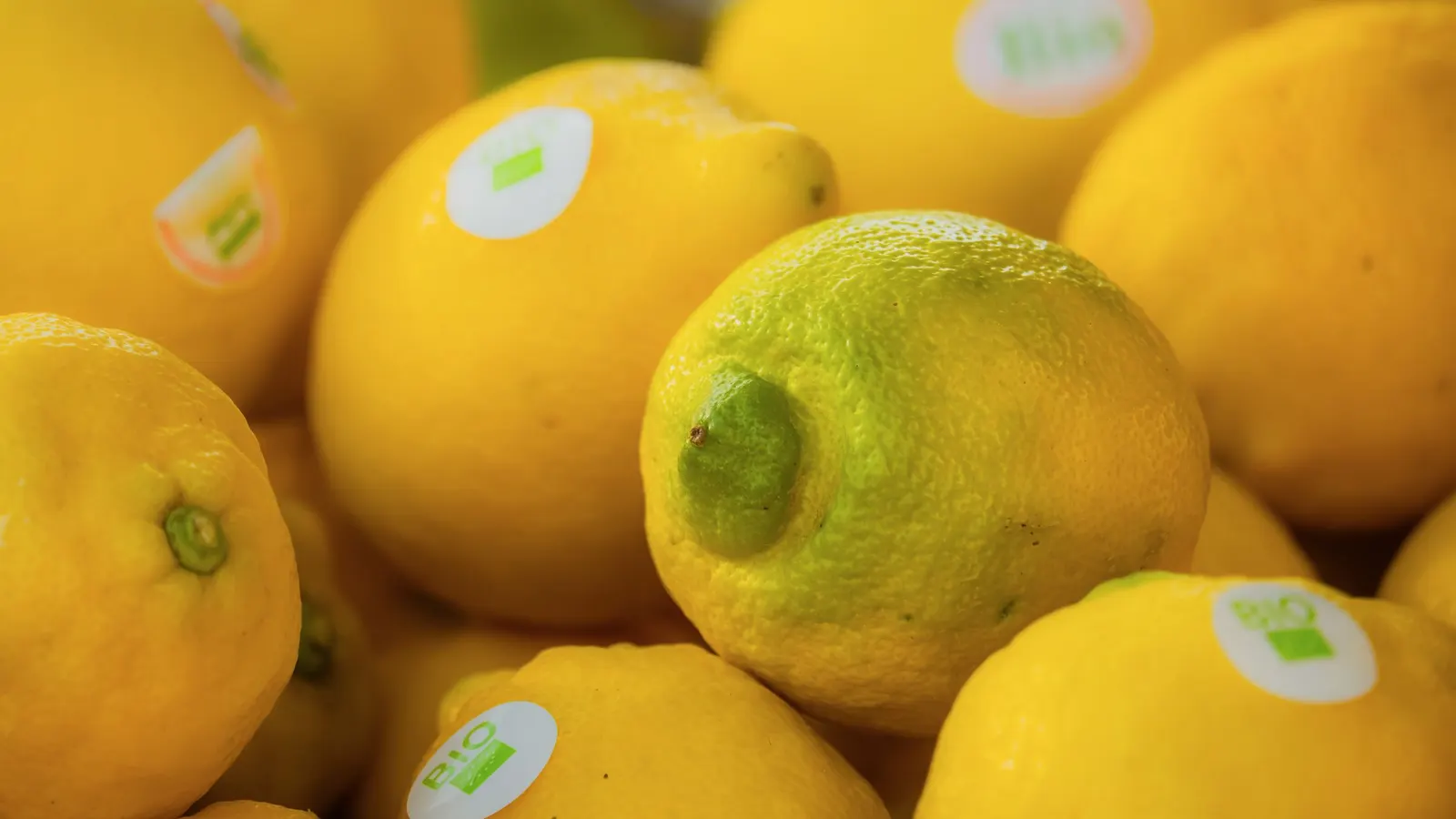
A sticker barely bigger than a thumbnail is becoming the test case for an entire industry. From 12 February 2028, sticky labels on fruit and vegetables must be compostable across the EU — the little plastic dot on apples, avocados and kiwis is on its way out. Industry is reacting surprisingly fast: two European manufacturers have just presented a label that breaks down in a home compost heap, adhesive included. Is this proof that regulation forces green innovation? Or is it the exception in a law that mainly keeps companies busy with forms?
- Legal basis
- Art. 9 PPWR, Regulation (EU) 2025/40
- Deadline
- 12 February 2028
- In scope
- Sticky labels on fruit and vegetables, tea and coffee bags, single-serve pods
- Minimum requirement
- Industrially compostable, e.g. under EN 13432
- Member state option
- May additionally require home compostability
- Time window
- According to the industry, a single harvest cycle for trials and tests
The sticker that is shaking up an industry
The problem is so small that nobody took it seriously for decades. Conventional produce labels are made of fossil-based plastic and an adhesive that does not degrade. They end up in the organic waste bin with the peel, survive digestion intact and reappear as microplastics in the compost. For composting plants they are a constant nuisance; for the legislator they were reason enough to name the label explicitly in Art. 9 PPWR.
The market responded faster than expected. On 17 September 2026, the British film manufacturer Futamura and the Dutch label specialist Bio4life presented a fully compostable self-adhesive label. The face material is a NatureFlex cellulose film; the adhesive, called BioTak, is certified home compostable. The label is designed for apples, citrus fruit, avocados and kiwis, available in transparent, white or metallised versions — easy to print and with a barrier against oils and chemicals.
The fresh produce industry has just one harvest cycle left to complete the necessary trials and tests.
That sentence is the real heart of the story. A new label does not just have to compost. It has to stick to wet, waxed or chilled skin, survive sorting and washing lines, stay legible for weeks in cold storage and run on the same machines as the old one. None of that can be settled in a lab — only in the season. Miss next autumn and you are testing under pressure in 2027, with the risk of reaching February 2028 without an approved label.
The case for innovation
The label is not an isolated case. The PPWR sets hard limits with fixed dates in many places, and that is exactly what changes the calculation in development departments. As long as sustainable packaging was voluntary, it remained a marketing project with an uncertain budget. With a deadline, it becomes a mandatory task for which materials, machines and suppliers actually have to be ready.
- Planning certainty creates demand. A manufacturer like Futamura does not develop a material on spec, but because an entire EU industry has to switch on a fixed date.
- The same rules for everyone. Companies that switched voluntarily used to pay extra and lose on price. When everyone has to, that disadvantage disappears.
- Design requirements reach into development. Recyclability grades (Art. 6), minimum recycled content for plastics (Art. 7) and the empty space ratio (Art. 24) force companies to rethink packaging from scratch rather than greening it after the fact.
- Money follows recyclability. Through eco-modulated EPR fees, poorly recyclable packaging becomes noticeably more expensive — a lasting incentive to improve.
The case for red tape
The other side has good arguments too. For every company developing a new material, there are hundreds that simply have to prove they are doing everything right. The PPWR has applied directly since 12 August 2026, and most of the effort so far has been documenting, not inventing.
- Technical documentation (Annex VII) and an EU declaration of conformity (Art. 39) for every packaging item — including those that do not change at all.
- Registration, volume reporting and, in many cases, an authorised representative in every country you ship to.
- Retention periods of five years for single-use and ten years for reusable packaging (Art. 15(3)).
- Pending implementing acts: for many requirements, the exact calculation and test methods are still missing. Companies are expected to plan today for what the Commission will only specify later.
There is also a fundamental objection: not every mandated solution is the best one ecologically. A compostable label only helps if it actually ends up in the organic bin and the local plant can process it. Where organic waste is mostly digested rather than composted, the benefit is smaller than the packaging promises. Critics see the familiar pattern: Brussels prescribes the outcome, and the infrastructure catches up later.
Innovation
- New materials such as cellulose film and compostable adhesives
- Lighter, smaller packaging driven by minimisation rules
- Mono-materials instead of hard-to-separate composites
- Demand for recyclate makes recycling economically viable
Red tape
- Documentation and declarations even for unchanged packaging
- Multiple registrations and representatives per target country
- Long retention periods for evidence
- Obligations whose test methods are not yet defined
Our take: both — and that is no contradiction
The honest answer: the PPWR drives innovation where it sets a clear technical goal with a fixed date. The produce label is a textbook example. Red tape arises where it demands evidence about things that do not change, and where the rules are still unfinished. Both hit the same companies at the same time, which explains the frustration. Those in the middle of a material switch are expected to build a file for every packaging item on the side.
The difference between winners and losers will therefore lie less in who finds the most creative material. What matters is who organises the mandatory part so that time and budget remain for the creative part. A company with clean packaging data knows early which formats will become critical in 2028 or 2030 and can test in time. A company that assembles every report by hand finds out too late.
Fruit and vegetable businesses: test now
If you label fruit or vegetables, schedule trials with compostable labels for the coming season. Check with your label supplier which certification is in place (industrial under EN 13432, additionally home compostable) and test adhesion, legibility and machine performance under real conditions. Also keep an eye on whether your target countries will require home compostability.
What you can do now
- Take stock of your packaging. Which formats do you use, made of which material, in what quantities? Without this list, any strategy is guesswork.
- Sort obligations by deadline. Compostability under Art. 9 from February 2028, recyclability and recycled content from 2030 — that turns a big law into a timeline.
- Involve suppliers early. New materials need lead time. Anyone who only asks in 2027 will compete with the whole industry for the same capacity.
- Standardise the mandatory part — or outsource it. Generate documentation, declarations of conformity and volume reports from a single data source instead of rewriting them for every packaging item. That is exactly what Reguly is for: you capture your packaging data once, and the platform turns it into technical documentation and a declaration of conformity, keeps the evidence archived in an audit-proof way and reminds you of upcoming deadlines. Your team works on the packaging, not the paperwork.
- Reinvest the time saved. Whatever you save on paperwork can go into trials and material development — where the PPWR actually creates a competitive edge.
Note
This overview is based on publicly available sources and is not binding legal advice. For an assessment of your individual case, please consult a lawyer or an accredited body.
Talk to us
Less paperwork, more time for innovation
The free PPWR check shows in ten minutes which obligations already apply to your packaging and which deadlines come next.
Start PPWR check