

EU AI Act
Competence you can actually evidence.
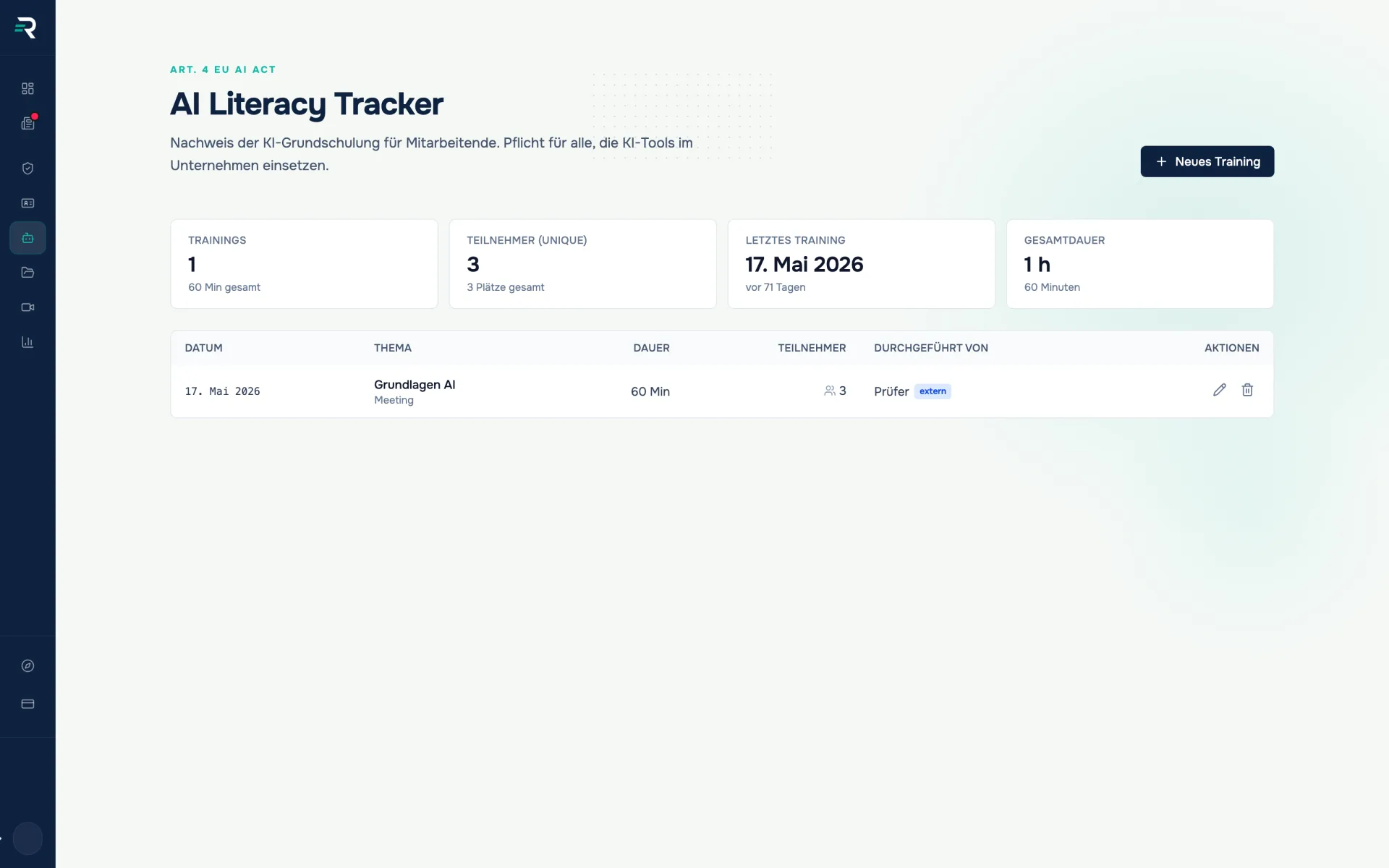
Art. 4 of the AI Act requires sufficient AI literacy in the people who operate your AI systems. The tracker turns that into a record rather than a claim.
- Regulation
- AI Act (EU) 2024/1689
- Context
- Art. 4 — AI literacy
- Module
- AI literacy tracker
- Reminder
- after 180 days
Ausgangslage
The training happened — only nobody can prove it
In most companies AI literacy grows on the side: an input in a team meeting, an external workshop, a session on the safe use of chat tools. A lot has happened. Little of it is documented.
- The training exists as a calendar entry, as a slide deck, in the memory of those involved — not as evidence.
- Whether the last round was four months or two years ago is something nobody can say offhand.
- When an audit comes up, the reconstruction from inboxes and calendars begins.
How you work with it
Settle which systems this is about
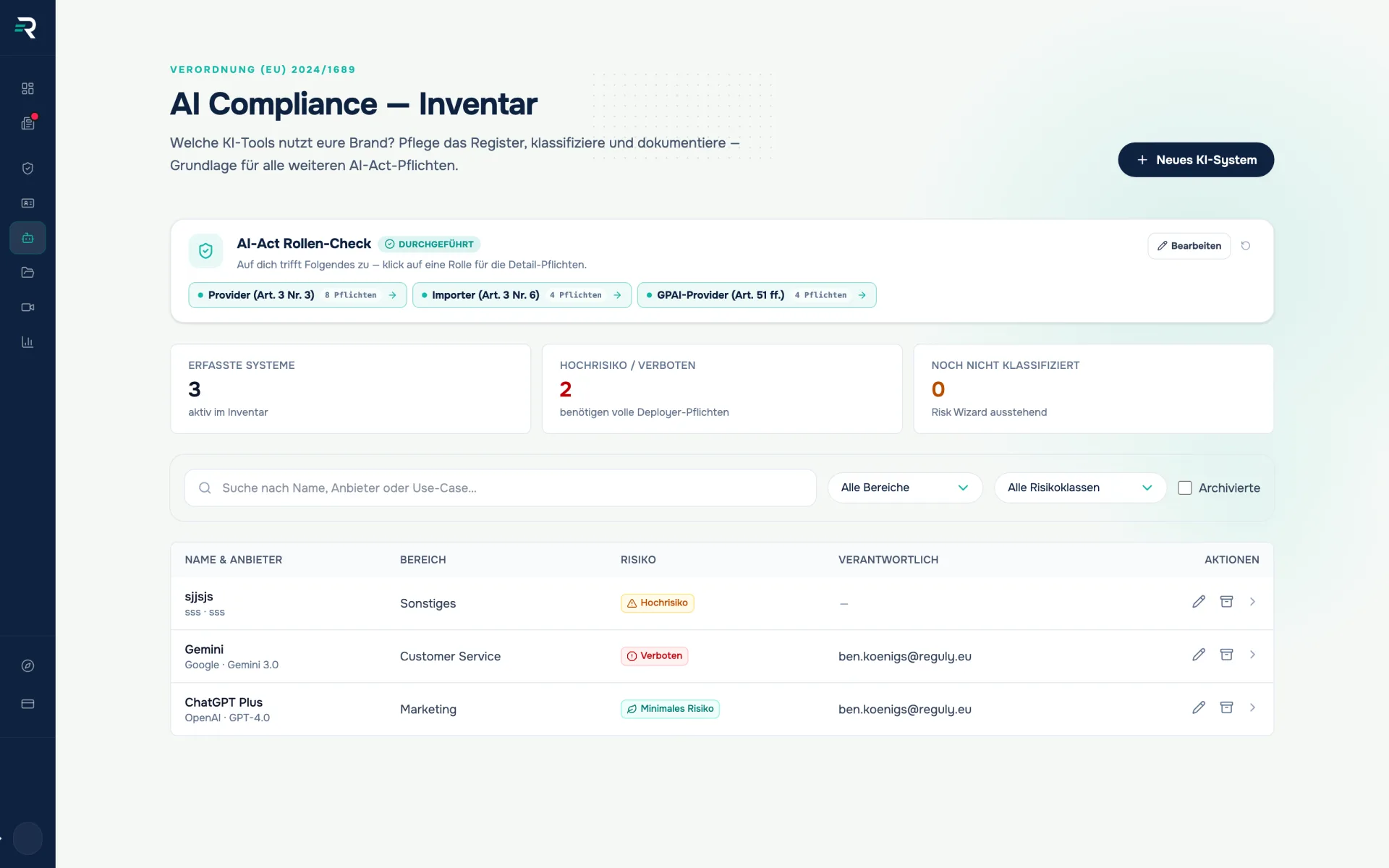
AI literacy hangs on the systems you use and on the people who work with them. The AI inventory holds both — provider, area of use, risk class, responsible contact. From that follows who should be trained and on what.
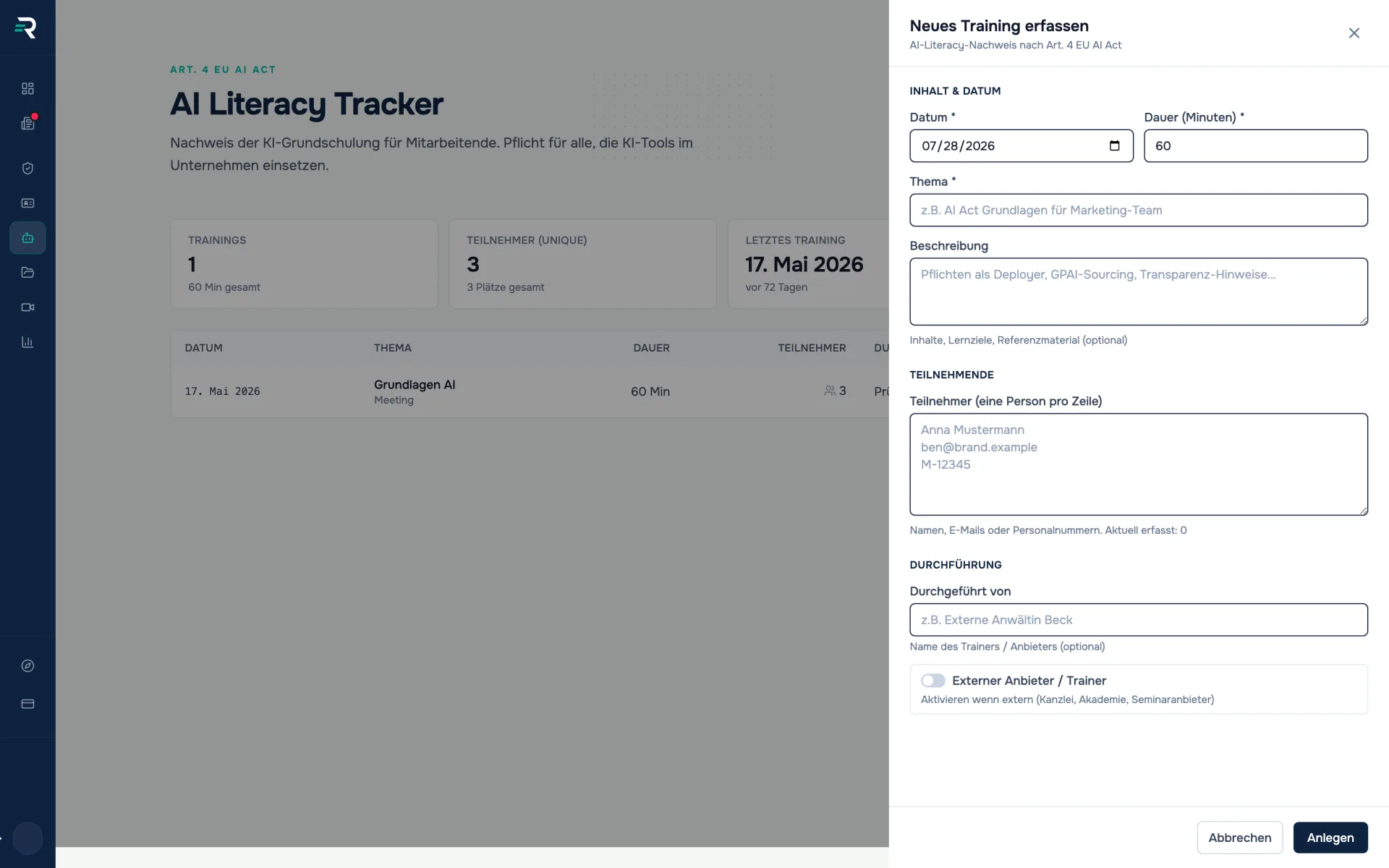
Capture every training in one entry
A training is recorded in one dialog: date, topic, duration, participants and the person delivering it, internal or external. There are deliberately no more fields — a record that demands twenty entries never gets kept.
See the state at a glance
Four figures for the whole brand: number of trainings, unique participants separate from the total number of seats, the last training with the days since, and the total duration. The answer to “where do you stand on AI literacy?” — in four numbers rather than a paragraph.
Be reminded before the evidence gets old
If the last training is more than 180 days ago, the figure turns amber and a note gives the number of days. The threshold does not come from the legal text — it is Reguly practice and the trigger to review the situation again.
Deployers of AI systems
You use AI in day-to-day work — from marketing through to HR.
Providers & compliance
You have to be able to show that the people behind the systems know what they are doing.
Management & law firms
You are accountable for the evidence without keeping attendance lists yourselves.
How it fits together
One set of data that carries forward
01
AI inventory
records which AI systems are in use
System & provider · Area of use · Risk class
02
AI literacy
evidences the competence of the people behind them
Training date · Participants · Duration · internal/external
03
Audit log
logs when what was recorded
Timestamp · Action · History
Frequently asked questions
What exactly does Art. 4 of the AI Act require?
Providers and deployers shall take measures to ensure, to their best extent, a sufficient level of AI literacy of their staff and of other persons dealing with AI systems on their behalf. What counts as sufficient depends on prior knowledge, context and purpose of use — the regulation does not name a number of hours.
Does Reguly prescribe how often training has to happen?
No. The 180-day mark is a practical threshold in the product, not a legal standard: after it, the tracker flags the situation as worth reviewing. Whether that rhythm suits you is your call — with your law firm where it matters.
Do I have to count external service providers?
Art. 4 also names persons dealing with the systems on your behalf. The participant list takes any names, and for the person delivering the training there is an “external” marker — an agency, law firm or training provider can be logged just like your own team.
Does the tracker replace legal advice?
No. Reguly operationalises the obligation — it documents what took place and makes gaps visible. Judging whether your level of competence is sufficient stays with you or your law firm.
Regulation (EU) 2024/1689 (AI Act), Art. 3 and Art. 4
Reguly app: AI literacy tracker at /dashboard/ai-compliance/literacy
Passt dazu
First know which AI is running in the building.
The AI inventory lists every AI system in use with its provider, area of use and owner — and classifies it into its risk class through a wizard.
Every piece of evidence is ready, none expires quietly.
The compliance vault keeps every piece of evidence in one place — test reports, certificates and declarations, versioned and with expiry monitoring.
Every change is on record before anyone asks about it.
The audit log records every change to your compliance data with timestamp, action and entity — filterable by entity type and action, with a diff per row.
Make AI literacy provable
In a short conversation we will show you how the AI Act module brings the inventory, the risk classification and the training records together.